witn vs Orb
Compare witn and Orb for AI agent billing. Where usage-based metering fits, where outcome-native billing wins and how to choose for your product.
By George Kats
The New Monetization Challenge for AI Agents
AI agents have moved past the experimental phase. They handle complex, multi-step tasks autonomously and that shift has exposed a monetization problem. Traditional billing models, flat subscriptions or simple usage metrics like API calls, were not designed for this. They measure activity, not achievement.
The disconnect cuts both ways. Builders fail to capture the value their agents create and leave revenue on the table. Customers pay for processes that failed or delivered nothing. The challenge is no longer tracking usage. It is quantifying value. Two distinct answers have emerged, embodied by witn and Orb. They are not just two billing tools. They are two different philosophies.
Foundational Billing Philosophies: Usage vs Outcome
Orb built its expertise around usage-based billing. It meticulously tracks and charges for the consumption of resources or the volume of events. Data processed, features accessed, seats used. It is an effective and transparent model for platforms where value scales predictably with consumption. The core question it answers: "How much did the customer use?"
witn is outcome-native. It looks past raw events to identify and charge for successful results. Instead of counting activities, it evaluates signals from your existing event streams to determine whether the agent achieved a predefined goal, like resolving a support ticket or qualifying a sales lead. The question witn answers is different: "What value did the customer receive?"
Usage-based billing is a robust solution for general SaaS. Applied to the goal-oriented work of AI agents, it becomes a blunt instrument. Charging for every action an agent takes, regardless of success, means billing customers for failed attempts and incomplete tasks. Outcome-native billing aligns cost with delivered value, so invoices reflect achievements, not effort.
| Aspect | Orb (usage-based) | witn (outcome-native) |
|---|---|---|
| Core question | How much did the customer use? | What value did the customer receive? |
| Billing trigger | Resources consumed (API calls, data stored) | Predefined goal achieved (ticket resolved) |
| Value measurement | Quantifies activity and volume | Qualifies success and results |
| Ideal for | Products where value scales with consumption | Products where value is tied to task completion |
| Invoice example | 10,000 API calls used | 15 support issues resolved |
Aligning Infrastructure with Your Business Model
Orb is an excellent fit for high-growth SaaS and AI companies whose value proposition is tied to quantifiable usage. If your product is a data API, a cloud infrastructure service or a platform where more activity directly means more customer value, a usage-based model gives you a clear and scalable path.
witn is purpose-built for AI agent builders. For them, value is not the number of steps an agent takes. It is the objectives the agent completes. An analogy makes the difference concrete. Orb operates like a utility meter, precisely tracking every kilowatt-hour consumed. witn functions like a performance contract, where payment depends on achieving an agreed result.
Four questions point you to the right model:
- Is your product's value defined by consumption or by achievement?
- Do your customers care more about the resources they used or the problems they solved?
- Does your pricing need to account for failed or incomplete agent tasks?
- Is your goal to bill for activity or to prove delivered value?
If your answers lean toward achievement, you need what we call a resolution layer. We wrote about why that layer is missing from traditional billing stacks in The Missing Layer in AI Agent Monetization.
Flexibility in Pricing and Implementation
Both platforms are flexible. They apply flexibility in different dimensions.
Orb's strength is decoupling product logic from billing logic. Commercial teams can experiment with tiered plans, per-seat pricing or credit systems without engineering work. That is the right setup for companies iterating on packaging across a broad user base.
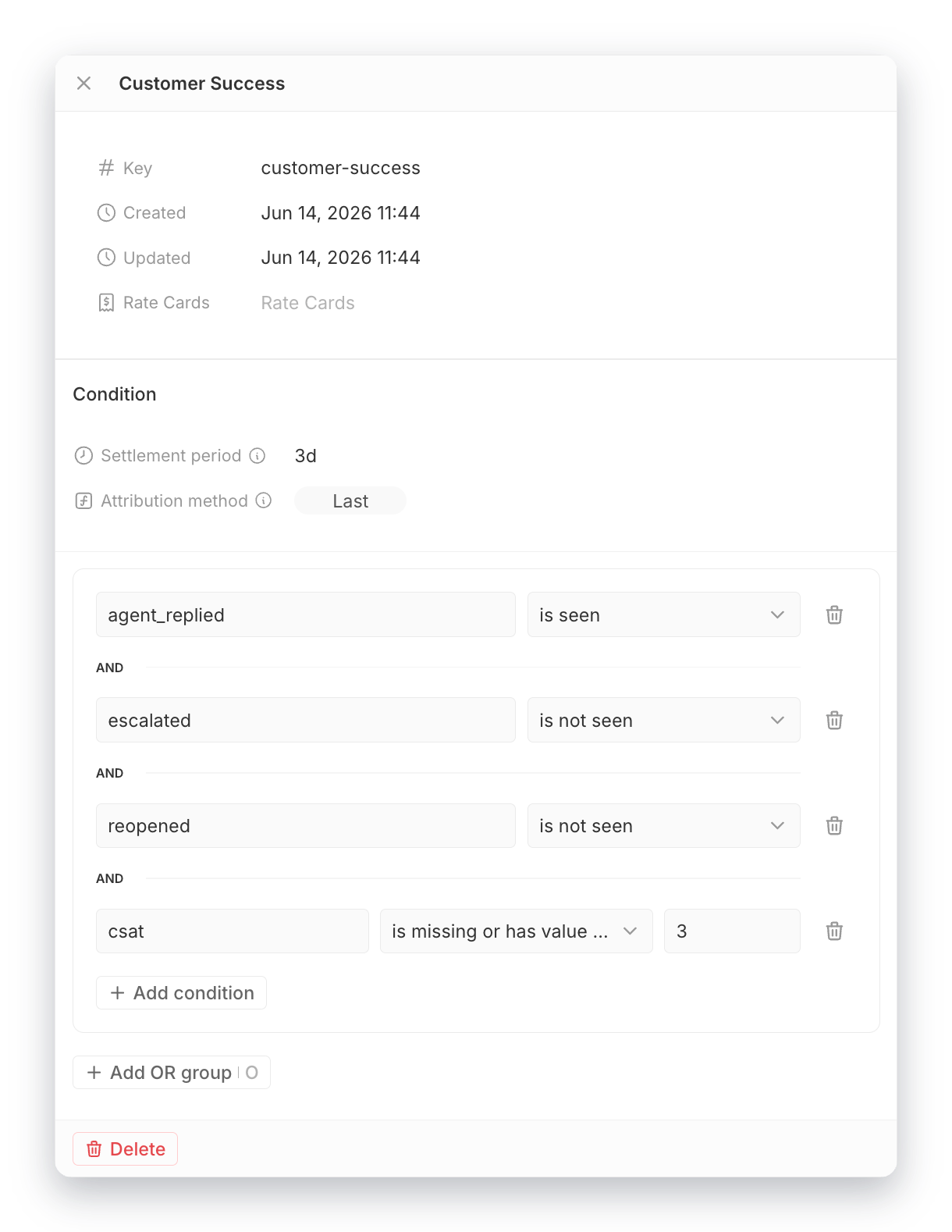
witn's flexibility is focused on value definition. Success criteria are explicit billable conditions, rules an outcome must satisfy before it becomes a charge:
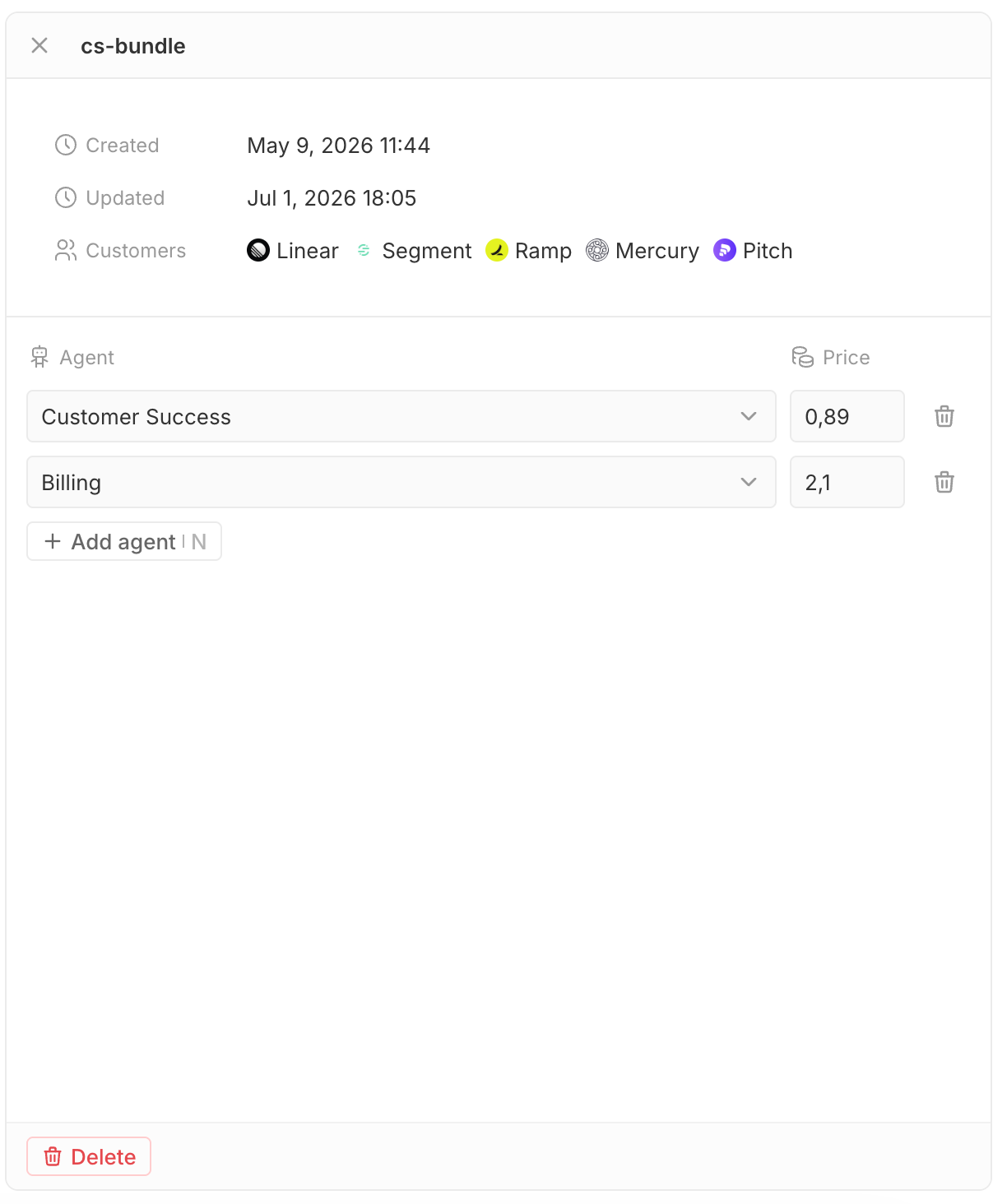
Per-customer contracts come from rate cards. Each customer gets their own agent-to-price mapping, so the same outcome carries different prices for different customers without forking your billing logic. That matters for enterprise clients whose definition of a "successful outcome" is their own:
A key differentiator is simulation. witn lets you model the financial impact of a pricing or condition change before deploying it, previewing how the change affects resolved outcomes and revenue. We covered the method in How to Test Your Outcome Pricing Model Before Launch. Orb's flexibility is geared toward broad pricing iteration. witn's is geared toward defining and proving value at a granular, per-customer level.
From Raw Event Data to Contextual Invoices
The journey from raw data to invoice shows the practical difference. Orb ingests raw event-level data at scale and creates a comprehensive, auditable record of usage. The invoice reflects that activity: "10,000 API calls used" or "500 GB of data processed". Precise, auditable and ideal for showing resource consumption.
witn uses the same event streams differently. It evaluates them for signals, interpreting the context behind the events to resolve billable outcomes. The invoice reads as results: "15 support issues resolved", with each line item backed by the triggering event, the condition it satisfied and the settlement moment. We broke down that anatomy in How Transparent Invoicing Stops AI Billing Disputes.
This is more than cost justification. An invoice that tells a story of success builds trust and reinforces the value of your product with every billing cycle.
Frequently asked questions
How do witn and Orb differ?
When is Orb the better fit?
Does usage-based billing work for AI agents?
Can witn price the same outcome differently per customer?
Selecting the Right Billing Partner for Growth
The choice comes down to what you are selling. Orb is a powerful general-purpose usage-based billing engine that serves a wide range of SaaS and AI models well. If your business needs a scalable, flexible meter for quantifiable consumption, Orb is a strong contender.
witn occupies a different position. For builders whose entire value proposition is the results their agents achieve, witn is the most direct and transparent path to monetization. It was designed from the ground up on one conviction: billing should align with the fundamental promise of AI, which is to achieve goals. If your product is built to deliver outcomes, your billing system should be too. Read the docs to see how it works.
The complete monetization playbook

How to price, verify and bill the work your AI agent delivers. A practical playbook for founders, product leads and engineers, from choosing a pricing model to operating outcome-based billing in production. 17 pages, free download.
5 Paid.ai Alternatives for AI Agent Billing in 2026
Comparing Paid.ai with witn, Metronome, Orb, Lago and Nevermined. What each platform does well and how to pick billing infrastructure for your AI agent.
Building witn's Low-Latency Outcome Resolution Layer
Explore the engineering of a low-latency, high-reliability outcome resolution layer for AI agent billing. Learn how we solved for correctness and scale.