The Missing Layer in AI Agent Monetization
Metered billing falls short for AI agents. Learn why monetization needs a resolution layer that turns stateful agent activity into billable outcomes.
By George Kats
The Limits of Traditional Metering for AI Value
Metered billing has long been the standard for counting clear, discrete units of consumption. Platforms like Metronome excel at this. They track foundational costs such as API calls, data storage or GPU cycles. The model works when the value delivered is proportional to the resources used. For infrastructure, it is. You pay for what you consume.
A fundamental disconnect appears when the same model is applied to intelligent systems. The value of an AI agent is not in the compute it consumes but in the outcomes it achieves. An API call is an input, a single step in a longer process. A qualified sales lead delivered to a CRM is a business outcome. Counting the actions an agent takes is like paying a salesperson for the number of calls they make instead of the deals they close.
As agents become more autonomous, the gap between activity and achievement widens. Even the usage-based billing platforms see the shift. Metronome itself notes that AI companies will demand new approaches from their billing partners, approaches that go beyond simple metering. Monetization has to evolve from counting activities to validating achievements.
Why AI Agents Behave Like State Machines
To see why metering falls short, think of an AI agent not as a transaction processor but as a state machine. A billable outcome is the final, successful state in a sequence of actions, conditions and time constraints. It is not a single isolated event. In chess the value is in reaching checkmate, not in the individual moves. Each move changes the state of the game. Only the winning state has worth.
An agent's path to an outcome is stateful in the same way. The outcome resolves only when a specific combination of conditions holds:
- Product events. A sequence of user actions, API responses or internal calls.
- External signals. An update from a third-party system, like a CRM marking a lead as "qualified".
- Time windows. A constraint that something must happen or must not happen within a period. A lead converting within seven days. A booking staying uncancelled for 24 hours.
This stateful structure is what breaks standard billing systems, which are designed to ingest and rate predefined, stateless events. An agent tasked with booking a meeting might send an email, wait for a reply, parse the response for intent, check calendar availability and finally receive a confirmation. The billable event is the confirmed meeting, not the five preceding steps. Intercom's Fin prices this way in production: customers pay per resolution, a state the conversation reaches, not per message the agent sends.
The In-House Resolution Layer Dilemma
Faced with billing systems that cannot express this logic, engineering teams reach for a common workaround. They build a custom resolution layer in-house. The internal system listens to a stream of product events, manages the state of every potential outcome for every customer and idempotently emits a single billable charge when all success criteria are met. It solves the immediate problem and it introduces a permanent engineering burden.
Worse, it creates a black box. By the time a charge reaches the billing platform, the context of why it became billable has been stripped away. The invoice shows "1 Unit of Outcome X", a line item that is nearly impossible to explain, audit or dispute. We can all picture the support ticket that follows. A customer asks what they paid for and support has no answer, because the evidence lives in a separate, disconnected system. We covered the cost of that gap in How Transparent Invoicing Stops AI Billing Disputes.
The loss of context cascades. Billing feels opaque, so customer trust erodes. Support carries manual investigations. Finance struggles to reconcile and forecast revenue. The quick fix becomes long-term operational friction.
| Aspect | Short-term benefit | Long-term cost |
|---|---|---|
| Control | Full ownership of the logic | High maintenance and engineering overhead |
| Data context | Solves the immediate billing need | Context is lost before it reaches the invoice |
| Scalability | Works for the first few use cases | Brittle as products and contracts evolve |
| Flexibility | Custom-built for one need | Hard to adapt to new pricing models or customers |
Embracing an Outcome-Native Billing Approach
The in-house dilemma points to a more integrated answer: outcome-native billing infrastructure. Not another metering system. A purpose-built resolution layer designed for the stateful, multi-event nature of AI agents. It tracks the agent's state machine end to end, evaluates signals against contract terms and carries the full story into every invoice line item. The black box problem disappears because context is preserved from event to charge.
The approach starts with an explicit definition of success. Each outcome gets a billable condition, a rule the outcome must satisfy before it becomes a charge. We covered how to choose that definition in Defining Concrete Billable Outcomes for AI Agents. The condition is data, not code:
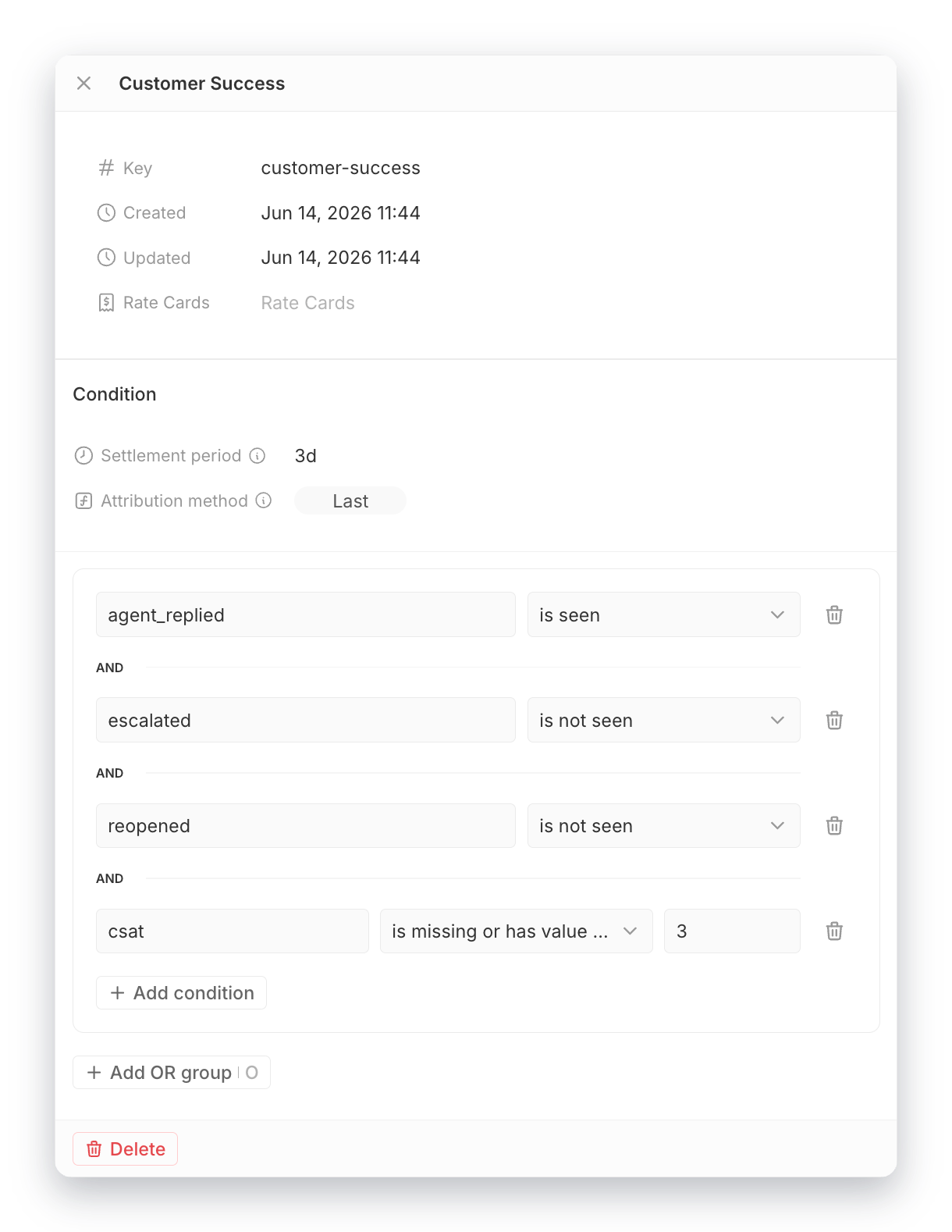
Because the definition is configuration, pricing stays agile. Changing "lead generated" to "lead converted" for an enterprise client is a configuration update, not a code deployment. Rate cards give each customer their own agent-to-price mapping without forking the core billing logic. And because conditions are explicit, you can test them before launch by replaying historical events, a process we walked through in How to Test Your Outcome Pricing Model Before Launch.
Decoupling Agent Logic from Billing State
For developers building these agents, one architectural principle matters most: decouple agent logic from billing state. A common mistake is to inject billing checks into the agent's core operational path. That adds latency and tangles product logic with monetization logic, making both harder to maintain. The agent's performance should never depend on checking whether an action is billable.
The clean separation runs asynchronously. Each component in the stack has one role:
- The AI agent. Executes the task and emits a stream of events describing its activity.
- The event stream. Tools like Segment or PostHog capture and route the activity data.
- The outcome resolution layer. Interprets the event stream against conditions and contract terms and resolves billable outcomes.
- The payment processor. A system like Stripe handles the final, context-rich transaction.
With this architecture, monetization never touches the agent's hot path. Events are fire-and-forget. The resolution layer does the stateful work off to the side and every charge still traces back to the events that caused it.
The resolution layer is one piece of a larger monetization stack. We map the whole journey in AI Agent Monetization: The Complete Guide.
witn is this resolution layer. Define the outcome as a condition. Send events as the agent works. The charge settles when the condition holds through the settlement window, with the full story attached. Read the docs to see how it works.
The complete monetization playbook

How to price, verify and bill the work your AI agent delivers. A practical playbook for founders, product leads and engineers, from choosing a pricing model to operating outcome-based billing in production. 17 pages, free download.
Pricing AI Outcomes as Risk Contracts
Learn to price AI agent outcomes as risk contracts. Move beyond simple unit pricing and build a ladder of offers that reflects true value.
witn vs Lago
Compare witn and Lago for AI agent billing. Where open source usage metering fits, where outcome-native billing wins and how to choose for your product.