Engineering Leader's Guide to Outcome-Based Pricing
A technical guide for engineering leaders on implementing outcome-based pricing for AI agents. Learn the data model, failure modes and rollout strategy.
By George Kats
The Hidden Complexity of Outcome-Based Pricing
Outcome-based pricing starts as a commercial decision but lands on your desk as a distributed systems problem. Engineering teams often estimate the work as a simple change to a billing table. They soon discover it is a complex event-sourcing project. This guide is not about why you should adopt this model. It is a technical blueprint for the engineering leader who has been tasked with building it correctly. We will cover the data model, the common failure modes and the practical steps for a successful outcome-based pricing implementation.
What Changes When Billing on Outcomes
Traditional billing models are deterministic. You count seats or meter API calls. The logic is straightforward because the billable unit is a simple counter. Outcome-based billing is fundamentally different. You are not counting activity. You are verifying a result. The billable moment is not a counter ticking up but a specific condition being met, often emerging from a complex sequence of events.
For AI agents, value is non-deterministic. An agent might take ten steps to resolve a customer issue or it might take two. Metering the steps misses the point. The value is in the resolution. This requires billing infrastructure capable of interpreting context from a stream of events to identify when a valuable outcome has actually occurred. The primitive is different, so the system must be too.
The Core Data Model: Events, Outcomes and Conditions
A robust system for outcome billing is built on three primitives. Understanding them is the first step in designing a correct architecture.
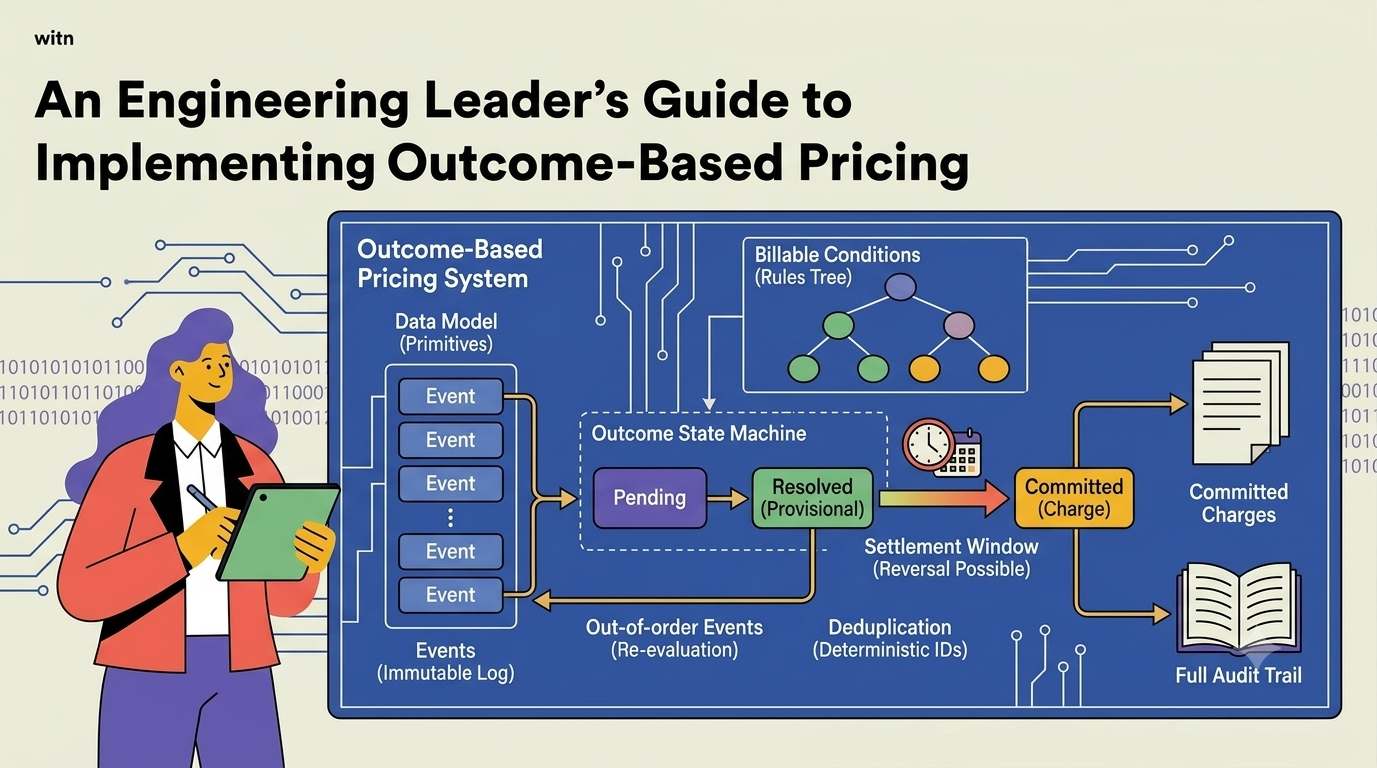
Events are immutable, timestamped facts. An agent emits an event for every meaningful action: ticket_created, user_responded, summary_generated. These events form an ordered, append-only log that serves as the single source of truth for all activity.
An Outcome is a state machine. It is uniquely identified by a key, such as a combination of customer and agent IDs. This state machine updates its state with every relevant event, ensuring the billable status is always current. This is a core principle of event sourcing for billing.
Billable Conditions are the rules that define a successful outcome. These are best expressed as a logical tree of AND/OR clauses that operate on event properties and time windows. For example, a billable outcome might be defined as: a ticket_created event is seen AND an escalated event is not seen within seven days. You can learn more about structuring these rules by exploring billable conditions in detail. The process of defining concrete billable outcomes for AI agents is a critical business and engineering exercise.
A critical architectural rule is to never re-derive state by re-scanning the event log on a schedule. The outcome state machine must process events as they arrive, keeping the billable state live and accurate at all times.
Four Failure Modes and How to Prevent Them
Building a resilient billing system means anticipating where it will break. Many teams fall into common traps when they first approach this problem. Below are four frequent failure modes and the correct architectural patterns to avoid them.
| Failure Mode | Naive Approach | Correct Approach |
|---|---|---|
| Idempotency and retries | Trusting each client call, leading to double-billing on retries. | Deriving a deterministic event ID from a client idempotency key to deduplicate requests. Ingest is asynchronous. |
| Out-of-order and late events | Processing events in arrival order, creating incorrect state. | Using the event's immutable timestamp to re-evaluate state, ensuring historical accuracy. |
| Reversals and cancellations | Treating a met condition as a final, irreversible charge. | Using a settlement window where a "resolved" outcome is provisional and can be reversed by later events. |
| Exactly-once charge effects | Calling a payment API directly from an event consumer, risking dual-writes. | Using a two-phase commit: settle the outcome first, then have a separate transactional process create the immutable charge. |
For idempotency, it is vital that event ingestion is a fast, fire-and-forget process. Acknowledge the event in single-digit milliseconds and handle the evaluation asynchronously. This ensures your billing system never adds latency to your agent's critical path.
Why the Settlement Window Is Crucial
The settlement window is the core mechanism that makes outcome-based billing fair and trustworthy. It addresses the reality that an outcome that appears complete can be reversed by subsequent events. A customer might reopen a "resolved" support ticket or cancel a booked appointment.
The lifecycle of a billable outcome should therefore be a multi-stage process:
- A billable condition is met.
- The outcome's state changes to "Resolved". This is a provisional status.
- The resolved outcome sits in a configurable settlement window, which can last from minutes to days.
- If no reversing events occur during this window, the outcome's state changes to "Committed". Only then does it become an immutable charge.
This built-in delay for corrections is not a bug. It is a feature that provides a clear and defensible process for handling disputes before they even happen.
Auditability Is a Non-Negotiable Requirement
You must design your system for auditability from day one. It is not a feature you can add later. Sooner or later, a customer will ask, "Why was I charged for this?". If your system cannot provide a clear, event-level answer, it is fundamentally broken. Every single charge must be traceable back to the exact sequence of events that triggered it. This is how transparent invoicing stops AI billing disputes before they start.
A well-designed system also enables replayability. This is the ability to run historical event data against new or modified billable conditions. This allows you to forecast the revenue impact of a pricing change before it ever touches a production environment. This is a powerful tool for de-risking business decisions.
Because the system state updates with every event, you can power real-time features that build trust. Spend caps, in-product usage meters and customer-facing dashboards can all run off this live state. This avoids the confusion that arises when a customer sees stale data from a nightly batch job.
The Build vs Buy Calculation
Now for the honest math. Building a correct, scalable and auditable outcome resolution layer is a significant undertaking. A conservative estimate is 3-4 senior engineers working for 2-3 quarters just to generate the first correct invoice. That does not include the permanent operational cost of an on-call rotation and capacity planning for what is now a mission-critical financial system. The hard parts are not the happy path. They are correctness under failure conditions and operational excellence.
The decision you face is strategic: is billing infrastructure your company's core differentiator or is it a tax on your product roadmap? For those considering the build path, understanding the deep engineering challenges of a resolution layer is key. For those evaluating external solutions, a buyer's guide to outcome-based AI pricing can offer a complementary perspective. Infrastructure like witn provides this resolution layer as a service: you define the outcome as a condition, send events and the charge settles when the condition holds through the settlement window.
A Phased Rollout Strategy
You should never test your billing system with a real charge. A phased, low-risk rollout is the only responsible path to production.
- Instrument and shadow. Start by instrumenting your agents to emit events. Collect this data in a shadow mode without any billing logic attached.
- Define and replay. Define your billable conditions and replay your historical event data against them. This validates your logic and gives you a baseline revenue forecast. This is where you can test your outcome pricing model before launch.
- Dry-run and reconcile. Run the full system, including the settlement window, in a dry-run mode. Generate mock invoices and reconcile them against your expected numbers.
- Launch with a segment. Go live with a single, trusted customer or a small, well-defined customer segment.
- Monitor and expand. Closely monitor the system's accuracy and performance before expanding the rollout to your entire customer base.
Your Billing System Is Your Promise
Outcome-based pricing is ultimately a contract of trust between you and your customers. That contract is not written in a legal document. It is enforced in your code. Getting the engineering right is not just a technical requirement. It is how you deliver on your core product promise of fairness and value.
The complete monetization playbook
How to price, verify and bill the work your AI agent delivers. A practical playbook for founders, product leads and engineers, from choosing a pricing model to operating outcome-based billing in production. 17 pages, free download.
witn vs Chargebee
Compare outcome-native and subscription models to find the right fit for your AI agent. Learn how witn and Chargebee approach value measurement and invoicing.
Moving Existing Customers to Outcome-Based Pricing
How to migrate existing customers to outcome-based pricing. A guide for AI founders on sequencing, comms and avoiding revenue loss.