AI Agent Monetization: The Complete Guide
How to monetize an AI agent in 2026. Pricing models compared, billable outcomes, risk tiers, backtesting, settlement and invoicing in one complete guide.
By George Kats
Every AI agent team eventually hits the same wall. The agent works, customers want it and nobody can agree on what to charge for. AI agent monetization is harder than classic software pricing because you are no longer selling access to a tool. You are selling completed work, and work can fail, be reversed or be disputed. This guide covers the full journey: why the old models break, what the market charges today, how to define and price a billable outcome, how to test the model before launch and what it takes to operate it in production.
Each section links to a deeper article or to the docs. Read it end to end for the full picture, or jump to the stage you are at.
Why AI agents break traditional software pricing
Traditional SaaS pricing rests on a quiet assumption: value scales with access. More users, more value, more seats. Agents break that assumption. An autonomous support agent handling thousands of conversations has no meaningful "seat". A coding agent that ships a fix at 3am was never licensed to a person.
Usage pricing looks like the natural fallback, but it prices your cost, not your customer's value. Worse, it punishes improvement. When a better model resolves the same ticket with fewer tokens, your revenue per task shrinks. We call this the innovator's paradox and unpack it in Why Your AI Product's Success Could Shrink Your Revenue.
There is a deeper technical mismatch too. Metering assumes each recorded event is final. Agent outcomes are not. A resolved ticket gets reopened. A booked meeting gets cancelled. A merged PR gets reverted. Billing for agent work means evaluating state over time, and traditional metering has no place to put that state. That gap is the subject of The Missing Layer in AI Agent Monetization.
The pricing models, compared
Six models cover the practical space. Most companies combine two of them.
| Model | What you charge for | Value alignment | Best for |
|---|---|---|---|
| Seat | Access per user | Low | Copilots tied to a human workflow |
| Usage | Tokens, calls, minutes | Low | Developer APIs, early platforms |
| Credits | Prepaid abstract units | Low to medium | Multi-feature products, enterprise procurement |
| Workflow | A completed multi-step task | Medium | Tasks that finish but whose impact is hard to verify |
| Outcome | A verified business result | High | Agents that can prove their impact |
| Hybrid | Platform fee plus a variable component | Depends on the variable part | Most mature companies |
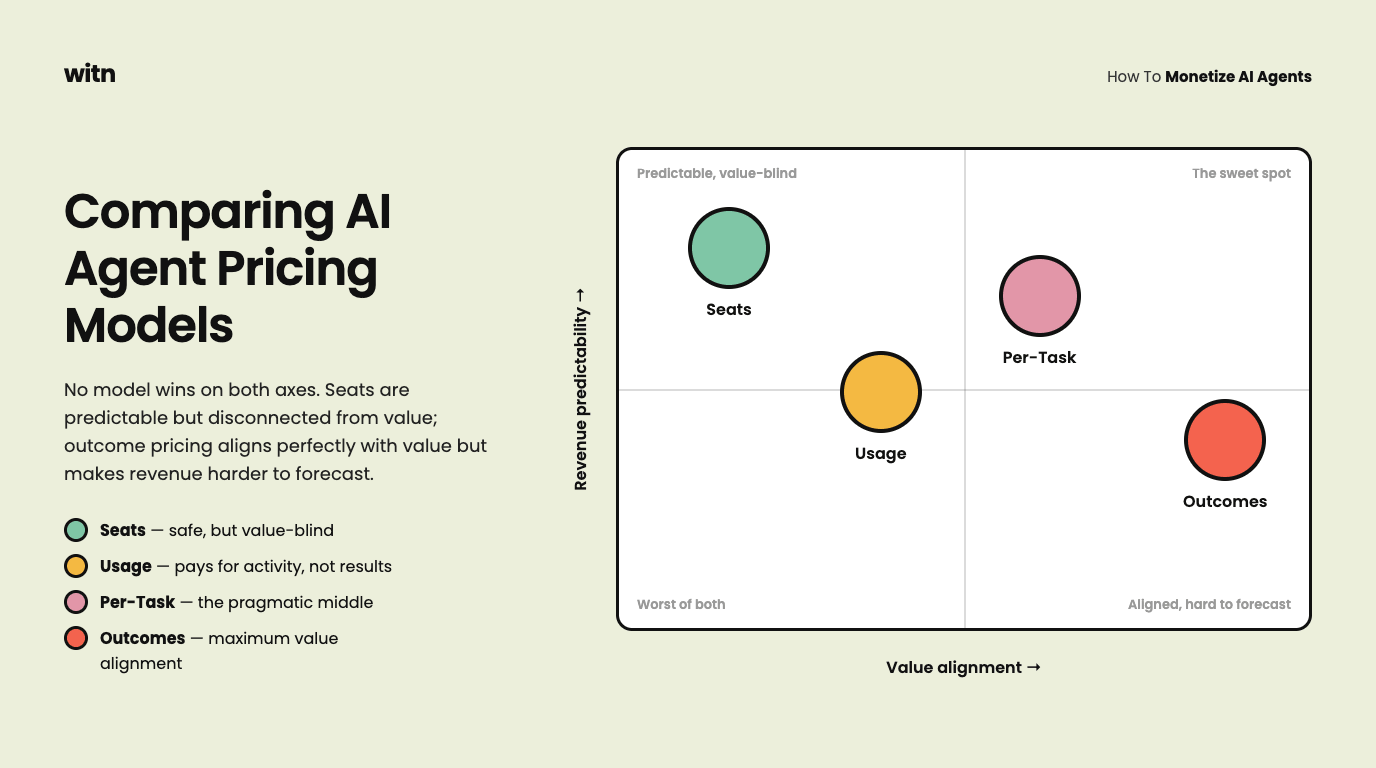
Seats work for copilots and unravel for autonomous agents. Usage is transparent but misaligned. Credits smooth the buying experience, and roughly a third of software companies have adopted them, yet they remain a cost-plus workaround with a better interface. Workflow pricing charges for "one processed invoice" regardless of compute, a real step toward value that still bills activity rather than impact. Outcome pricing charges only when a predefined, verifiable result is achieved. It is the strongest alignment and the hardest to operate.
The full decision framework, including the three questions that map you to a model, is in Strategies for Monetizing AI Agents: From Seats to Outcomes. The short version: if you cannot yet define or verify an outcome, start with usage or workflow pricing. If you can verify but cannot absorb revenue volatility, go hybrid. If you can do both, pure outcome pricing is the strongest position in the market.
What the market actually charges in 2026
Outcome pricing is not theoretical. In customer support it is already the reference model:
- Fin by Intercom charges a flat $0.99 per resolution with no platform fee. It is the market's pure outcome benchmark and its price point has become a psychological anchor for the whole category.
- Salesforce Agentforce charges around $2.00 per conversation, resolved or not, on its conversation model (it now also sells action-based Flex Credits and per-user licenses). At a 60 percent resolution rate that is an effective $3.33 per successful resolution, with the failure risk sitting on the buyer.
- Sierra sells enterprise per-resolution contracts, reportedly around $150,000 annual commitments plus implementation fees from $50,000 to $200,000.
- Decagon runs a hybrid: a platform fee around $50,000 plus a per-resolution rate, with one publicly discussed contract at $0.50 per resolution.
The numbers are less interesting than the fine print. Intercom cites an average resolution rate around 71 percent while independent reports place it between 42 and 50 percent, a gap explained entirely by what counts as "resolved". Vendors now differentiate on resolution definitions, reopen windows and auditability rather than on the headline rate. We break down the normalization math in AI Agent Pricing in 2026 and the contract fine print in What Counts as a Resolution?. The same shift is starting in other verticals: voice AI is still stuck on per-minute rates that tax slow conversations, a trap we cover in How Voice AI Companies Price Today.
How to define a billable outcome
The best billable outcomes are boring. Not "revenue influenced" or "pipeline generated", which end in attribution debates, but the small repetitive chores the customer used to do manually. A ticket resolved. An appointment booked. An invoice processed.
A defensible outcome has three properties:
- Observable. Both sides can point to the event and agree it happened.
- Repetitive. It occurs often enough that no single charge invites scrutiny.
- Hard to dispute. If you need a slide deck to justify the charge, it is a value narrative, not a billable outcome.
Then formalize it in one sentence: we charge when ___ happens and remains true for ___. The first blank is the smallest concrete event you can defend. The second is the time window that absorbs cancellations and reversals. "A support ticket is marked resolved" and "72 hours without a reopen" together form a complete billing specification. That sentence translates directly into a machine-checkable billable condition: a boolean rule over the events your system already emits, with the time window as the settlement period.
The full discipline, including a worked comparison of weak and strong outcome definitions, is in Defining Concrete Billable Outcomes for AI Agents.
Price the risk, not just the outcome
"Do you charge per outcome?" is the wrong question. The right question is "which outcome?". An outcome is a package of risk transferred from the customer to you, and every condition you add to its definition transfers more.
Take an appointment-booking agent. "Appointment booked" is cheap because the customer still carries the no-show risk. "Appointment booked and occurred" costs more because you now absorb that risk. "Appointment occurred and the customer was satisfied" costs the most because you are also underwriting quality. One agent, three products:
| Outcome definition | Risk holder | Example price |
|---|---|---|
| Appointment booked | Customer | $1 |
| Booked and occurred | Shared | $5 |
| Occurred and verified satisfied | Vendor | $12 |
Instead of hunting for the one right price, build the ladder and let each customer choose how much certainty to buy. Every rung must be verifiable, because a promise you cannot verify is a promise you cannot bill. The method for structuring and pricing the tiers is in Pricing AI Outcomes as Risk Contracts.
Test the model before you launch it
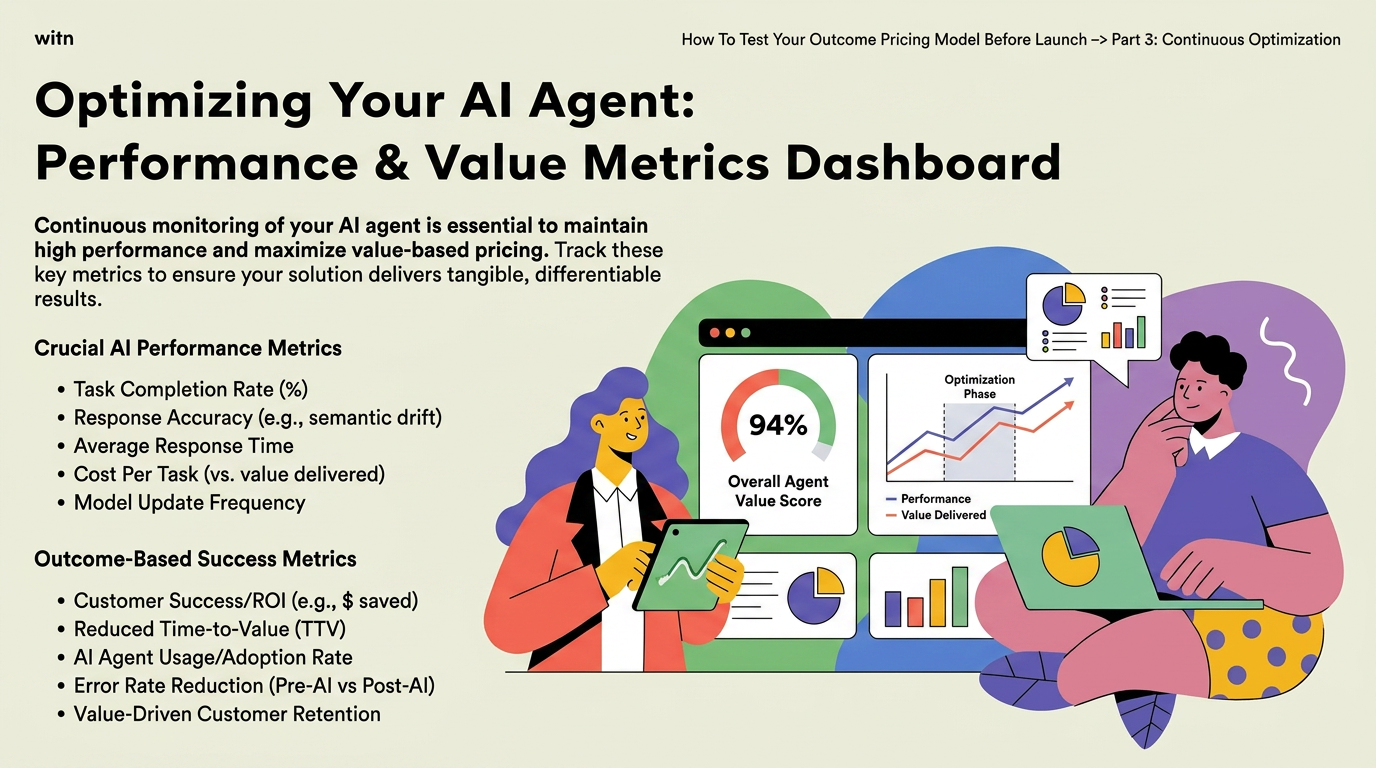
You do not have to guess what outcome pricing does to your revenue. You already have the data to know. Replay your historical events, the user actions and status changes already sitting in Segment, PostHog or your own event log, through the proposed outcome definition. The output is a line-by-line invoice showing what each customer would have paid last quarter under the new model.
That backtest turns an abstract pricing debate into a financial document. It shows which customers get cheaper, which get more expensive and what happens to your revenue if the agent's resolution rate improves by ten points. Run it before every definition change, not just at launch. The full method, including how to validate the model with design partners, is in How to Test Your Outcome Pricing Model Before Launch.
Operating outcome billing in production
This is where most teams underestimate the work. Between "the agent did the job" and "the customer was correctly charged" sits a pipeline that has to be right every time:
- Verification. Every event is folded into the outcome's state and the billable condition is re-evaluated. Not a one-time check: state accumulates across events and time.
- Settlement. A result stays provisional until a settlement window passes without contradiction. A reopened ticket inside the window means no charge. In witn the outcome lifecycle runs OPEN to CONFIRMED or missed, with a default 72-hour window extendable to 180 days, and every new event resets the timer.
- Exactly-once effects. Duplicate events must not double-charge. Out-of-order events must not corrupt state. The engineering behind sub-10ms ingestion and idempotent billing effects is in How We Built witn's Outcome Resolution Layer.
- Explainable invoices. Each line item should carry the outcome, the condition it satisfied, the triggering events and the settlement moment. When the invoice explains itself, disputes stop being support tickets. The anatomy of a self-explanatory line item is in How Transparent Invoicing Stops AI Billing Disputes.
- Per-customer pricing. The same outcome carries different prices for different customers via rate cards, without forking billing logic.
Build or buy the resolution layer
You can build this in-house. Teams that try usually discover they are building a second product: a stateful event pipeline with financial correctness requirements, exactly-once semantics and an audit trail, maintained forever next to the agent that actually makes money. The trade-offs are laid out in The Missing Layer in AI Agent Monetization.
If you buy, match the tool to your model. Usage metering platforms are excellent at what they do and stop at recorded consumption. We compare the landscape in Metronome Alternatives After the Stripe Acquisition, 5 Paid.ai Alternatives for AI Agent Billing and head-to-head in witn vs Orb. The dividing line is always the same: metering platforms answer "how much did the customer use?" while an outcome layer answers "what value did the customer receive?".
A maturity path, not a one-time choice
Almost nobody starts at pure outcome pricing and that is fine. The realistic path:
- Launch on usage or workflow pricing while the agent earns trust.
- Instrument outcome events from day one, even though you are not billing on them yet. This is the single highest-leverage move in agent monetization. It turns a future pricing migration into a configuration change and gives you the historical data for backtesting.
- Move to hybrid once the agent reliably delivers. A platform fee for the floor, an outcome component for the alignment. A common readiness benchmark is the agent returning at least 3x its cost to the customer.
- Shift weight to outcomes as your verification confidence grows, using the risk ladder to price the guarantees you take on.
Frequently asked questions
How do you monetize an AI agent?
What is outcome-based pricing for AI agents?
How much do AI agents charge per resolution in 2026?
When is an agent ready for outcome-based pricing?
Should I charge per seat, per usage or per outcome?
Where witn fits
witn is billing infrastructure for the outcome end of this guide. Define what a successful outcome looks like as a condition. Send events as the agent works. witn verifies the condition, waits out the settlement window, handles reversals and produces invoices where every line traces back to the result that earned it. Start with the docs or the quickstart.
Deloitte ASC 606 Guidance for Outcome-Based Pricing
A CFO's guide to Deloitte's ASC 606 for AI agents. The five system requirements for auditable outcome-based billing.
AI Agent Pricing in 2026: Fin, Sierra, Decagon
Real 2026 AI agent pricing from Fin, HubSpot and Salesforce. Calculate the true cost per successful resolution to choose vendors wisely.