How Transparent Invoicing Stops AI Billing Disputes
Reduce billing disputes and lower support costs for your AI product. This guide shows how to build transparent, self-explanatory invoices that earn trust.
By George Kats
The Operational Cost of Vague AI Bills
For companies building with AI, billing disputes are more than a nuisance. They are a recurring operational tax. A monthly seat license is predictable. The value an AI agent delivers is not. It changes with every task. That makes a bare invoice line item feel abstract, disconnected from what the customer experienced inside the product.
When a customer sees a charge that does not match the value they perceived, their confusion is justified. They are right to be angry. The customer does not care which internal system is technically correct. They care that the bill does not match the version of reality they were shown.
Every one of these disputes costs you. Support investigates. Engineering digs through logs. Finance issues credits to keep the relationship. The most effective way to reduce billing disputes is to prevent them. Build the explanation into the invoice itself.
Where Context Is Lost Between Action and Invoice
The path from a billable AI action to an invoice line item is where things go wrong. It works like a game of telephone. The context of the outcome gets lost at each handoff between product, operations and finance.
The fastest way to manufacture a dispute is to let each team decide for itself what "done" means. Product counts a task as complete when the agent finishes. Operations counts it when the customer accepts it. Finance counts whatever lands in the usage export. Without one shared definition, inconsistencies are guaranteed.
The deeper problem is timing. The context of an outcome usually disappears long before it reaches the billing system. When a customer questions an invoice, the teams downstream of billing cannot answer on their own. They escalate to product. One disputed line item becomes a multi-team investigation. Run that process every day and the margin you thought you had quietly leaks out as support cost. The profitability of outcome-based billing depends on closing this gap.
A Resolution Ledger as the Single Source of Truth
The fix is to treat the outcome ledger as a core part of your billing infrastructure. Not an internal log. A customer-visible, verifiable record that everyone references. Customers, support, RevOps and product all read the same data. There are no conflicting versions of reality left to argue about.
A resolution ledger records every billable outcome. It holds three things: the outcome that was resolved, the evidence that confirmed it and how it was classified for billing. Make this ledger the definitive record and the invoice changes character. It stops being a demand for payment. It becomes a defensible statement of value delivered.
The test is simple. A question about the bill should be answerable from the line item itself. That works when the record the customer sees is the same record the billing system charged from. There is nothing left to reconcile after the fact.
The Anatomy of a Self-Explanatory Line Item
A dispute-proof invoice answers questions before they are asked. This is what transparent invoicing means in practice. Every charge carries its own explanation. Take a voice AI agent that books appointments over the phone. When a customer opens a line item, they should see a complete story with three parts:
- The triggering event. The specific action that started the charge. An API call, a user action or a system process. For example, "Voice agent completed booking call #C-2847".
- The billable condition. The explicit rule that made the event billable, as defined in the customer's contract. For example, "Appointment confirmed on the calendar and not cancelled within the settlement window".
- The settlement moment. The exact timestamp when the outcome became final and turned into a charge. This gives you an unambiguous audit trail of when value was delivered and recorded.
This is what a billable condition looks like when it is defined explicitly. Every rule is visible and every rule is checkable:
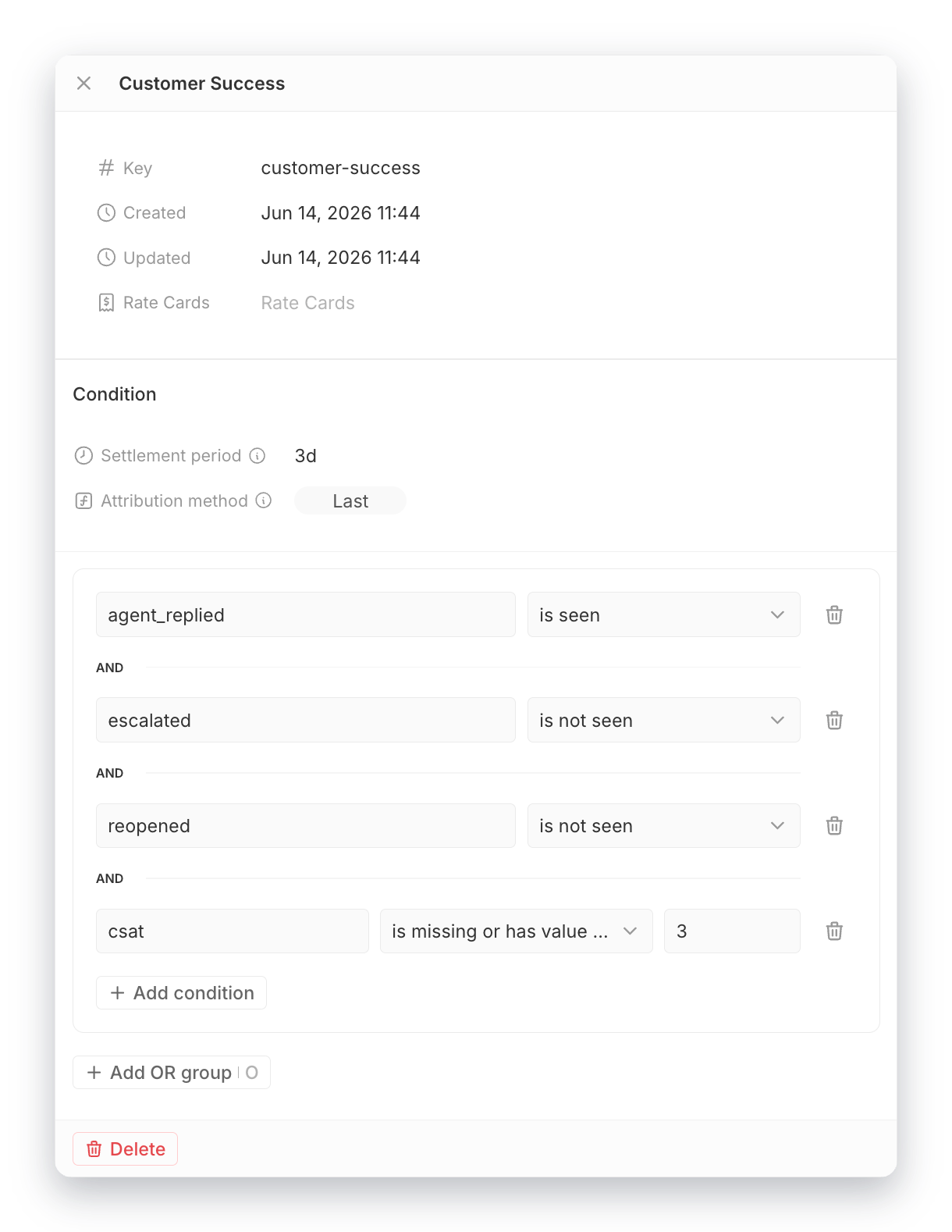
With this in place, support resolves inquiries on the spot. Nothing escalates to engineering. The difference is stark:
| Component | Vague line item | Transparent line item |
|---|---|---|
| Description | AI Usage - Unit | Appointment booked by voice agent |
| Triggering event | Not specified | Voice agent completed booking call #C-2847 with +1 555 013 2277 |
| Billable condition | Not specified | Outcome met the appointment_booked condition: booking confirmed, no cancellation seen |
| Settlement moment | Not specified | Settled and charged on 2026-10-26 at 15:30 UTC |
Context turns an ambiguous charge into a verifiable record of value delivered.
Architectural Principles for Deterministic Billing
Delivering this transparency reliably takes deliberate architecture. Two properties are non-negotiable in any billing pipeline: determinism and idempotency. They prevent double counting and missed events. Keep billable metadata separate from general operational logs. Give every event a unique ID so each invoice line item traces back to its source. That is your auditable path from action to charge.
A sidecar pattern makes this practical. Emit billing events from your application and classify outcomes asynchronously, off the hot path. Your core product stays fast and free of billing logic. Stripe makes a similar point in its guide on usage-based billing: usage-based models are complex, which is exactly why billing best practices matter. A well-designed system also handles the ugly cases gracefully. Late-arriving events. Outcomes that need a human review. A settlement window absorbs both without breaking accuracy.
Pricing Agility Without Chaos
A common worry is that a centralized billing system slows down pricing iteration. The opposite is true. When you monetize AI agents, outcome definitions change constantly. Custom contracts, pricing experiments, new features. That agility is a competitive advantage and it needs a safe place to live.
The wrong answer is letting every team invent its own billing logic. That path ends in technical debt and inconsistent customer experiences. The right answer is centralizing the ability to change. Keep outcome definitions in one place. Teams reprice and redefine quickly. There is still only one version of the truth. You get per-customer pricing without forking your core billing logic.
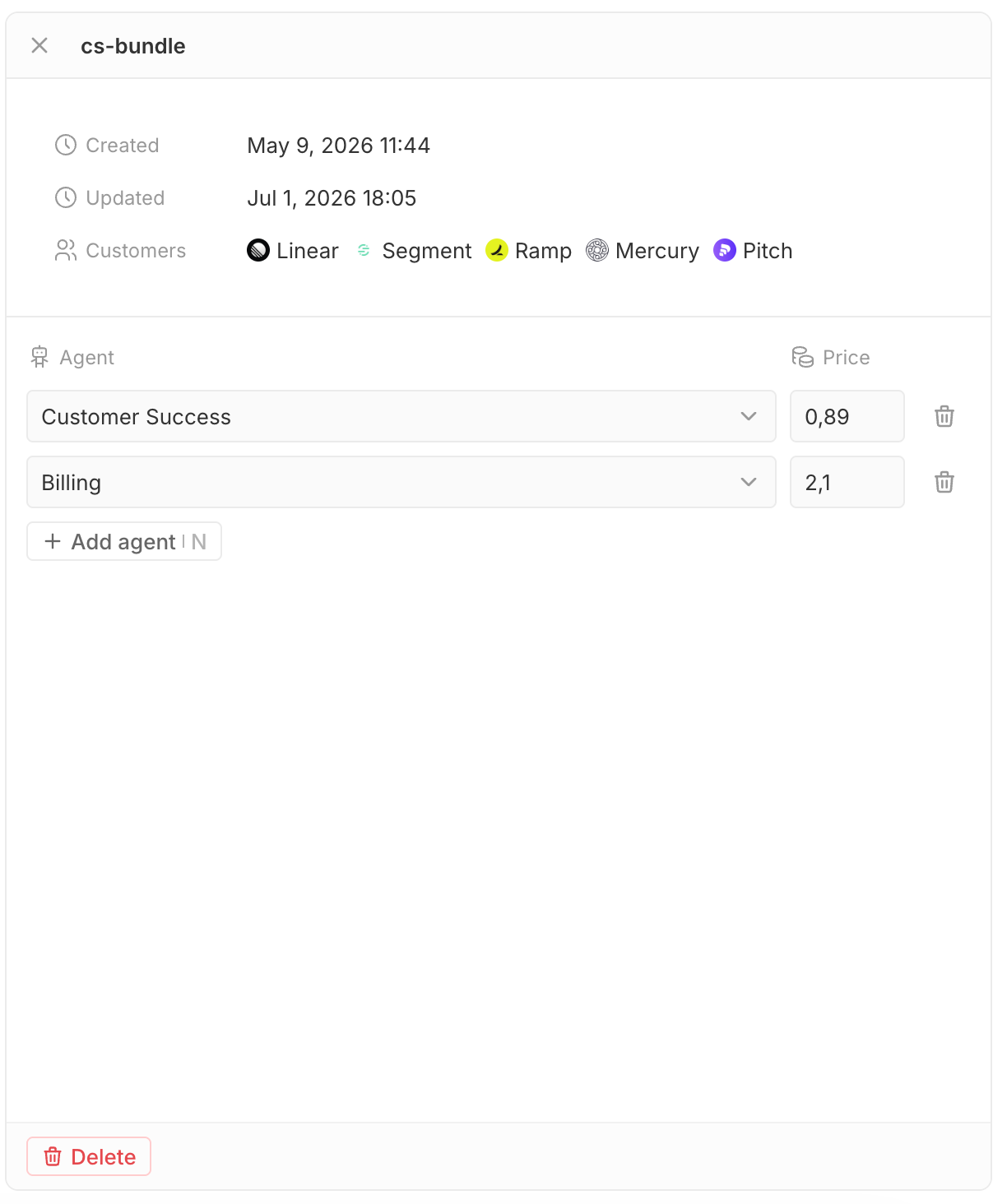
Rate cards make this concrete. Each customer gets a card that maps agents to prices, so the same outcome can carry different prices for different customers:
witn is billing infrastructure built on exactly these ideas. Define what a successful outcome looks like. Send signals as events. Charges settle automatically when outcomes are verified. Read the docs to see how it works.
The complete monetization playbook

How to price, verify and bill the work your AI agent delivers. A practical playbook for founders, product leads and engineers, from choosing a pricing model to operating outcome-based billing in production. 17 pages, free download.
Why Per-Minute Billing Is a Trap for Voice AI
Why per-minute billing traps voice AI companies. How outcome-based pricing aligns incentives with the value you deliver.
Why Selling AI Got Hard: Proof, Not Promises
Find out why AI deals are stalling in 2026. Buyers demand proof, not promises. Learn how outcome-based pricing builds trust and closes deals.