Why Selling AI Got Hard: Proof, Not Promises
Find out why AI deals are stalling in 2026. Buyers demand proof, not promises. Learn how outcome-based pricing builds trust and closes deals.
By George Kats
The Pattern Every AI Seller Recognizes
You know the feeling. The demo was perfect. Your champion was enthusiastic and saw the value immediately. You had a warm introduction and the initial calls went better than expected. They talked about budget and timelines. Then the communication slows down. Emails get shorter. Follow ups go unanswered. The deal is not dead. It is just stuck.
This is the question echoing through sales communities right now. Why are my AI deals stalling? You are not alone in asking it. Founders and sales leaders everywhere are describing the same pattern. A prospect loves the technology but will not commit. The deal enters an endless evaluation cycle and eventually fades away. Your champion goes quiet or tells you they are waiting for internal alignment.
This is not a reflection of your product or your sales skills. It is a market shift. The problem is not a lack of interest. The problem is a lack of trust. Buyers are no longer willing to sign a contract based on a promise. They need to see the value for themselves. They need proof that your AI will work on their data and solve their specific problems before they commit a single dollar of budget.
Why Buyers Stopped Believing in Promises
The current wave of buyer skepticism is not irrational. It is pattern recognition. For the past few years organizations have poured resources into AI initiatives. The results have been deeply disappointing. Every enterprise buyer you speak with has a story about a failed pilot or an expensive project that delivered no measurable return. They have been burned before and they have learned from it.
The data confirms their experience. The gap between the promise of AI and the reality of its impact is wide. Consider the evidence from the last two years.
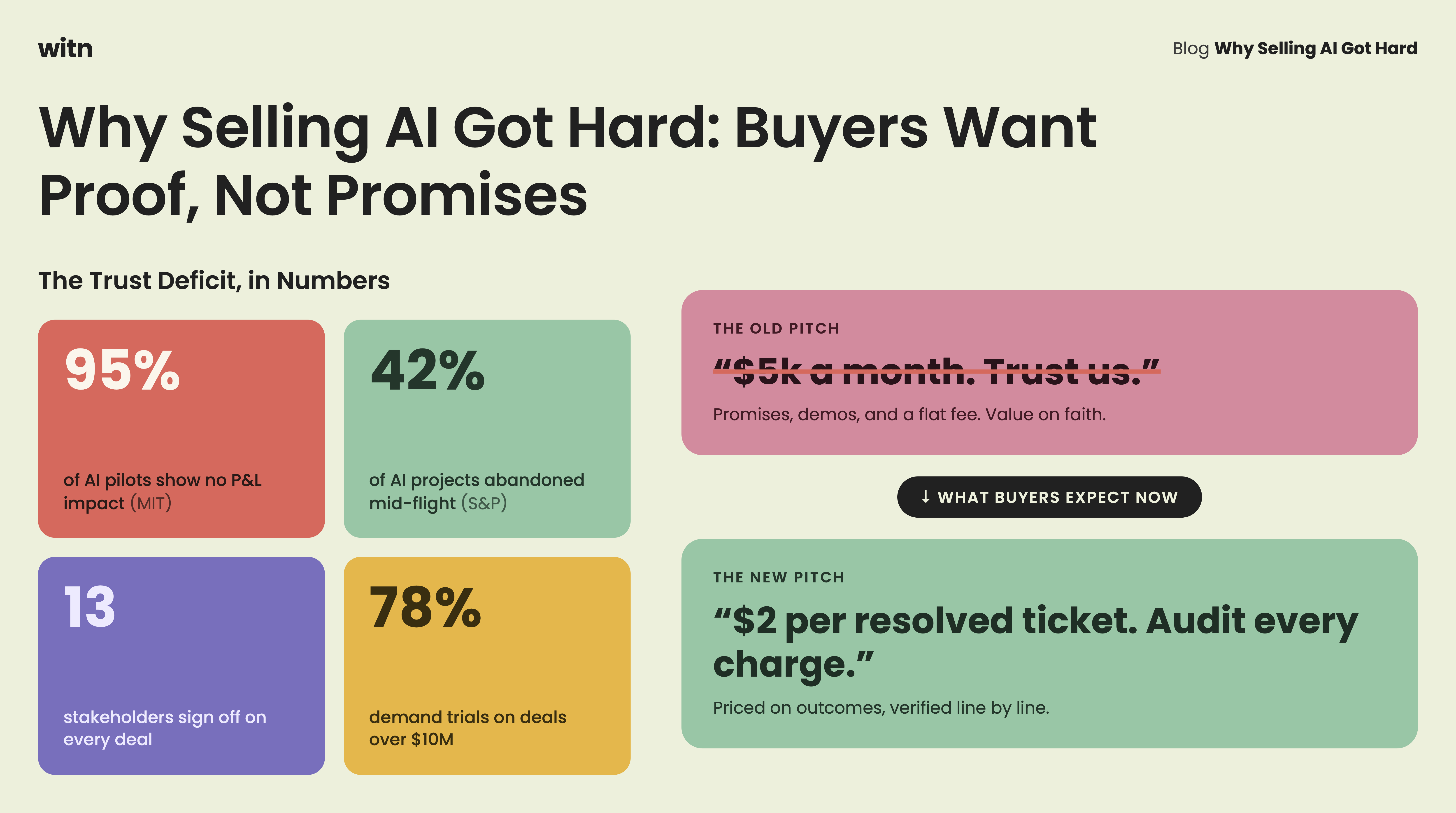
- An MIT study found 95 percent of AI pilots deliver zero measurable P&L impact.
- S&P Global reported that 42 percent of companies abandoned most of their AI projects in 2025.
- A Deloitte survey showed that while 74 percent of organizations want AI to grow revenue, only 20 percent have actually seen it happen.
- Morgan Stanley found that only 21 percent of S&P 500 companies can cite a measurable AI benefit from their investments.
These are not isolated incidents. They represent a widespread failure to translate AI potential into business results. These are the stories your buyers have in their heads when you present your slide deck. They are no longer buying a vision. They are buying a verifiable outcome.
The New Buying Process This Created
This trust deficit has fundamentally changed how enterprises buy AI. The old playbook of selling a vision and promising future ROI is broken. Buyers have built a new purchasing process designed to protect them from another failed investment. Resisting this new reality is a losing strategy. The sellers who win are the ones who design their sales process to accommodate it.
A Forrester report from late 2025 put it plainly. B2B buyers now demand proof, not promises. This is not just a sentiment. It is a structural change in how decisions are made. More than 60 percent of business buyers now use a trial before committing to a purchase. That number jumps to 78 percent for investments over ten million dollars. The "try before you buy" model is now the standard for significant software purchases.
At the same time the number of people involved in a decision has grown. The median B2B purchase now involves 13 internal stakeholders. Each of those stakeholders brings their own questions and their own skepticism from past projects. The burden of proof has shifted entirely onto the vendor. You must prove your value before a contract is ever signed. Your job is no longer to convince them it will work. Your job is to show them it works.
Move the Proof into the Deal
If buyers need proof, the only logical step is to build that proof directly into the deal itself. Instead of fighting for trust you can create a commercial structure that makes trust irrelevant. This approach aligns your success with your customer's success. It turns a contentious negotiation into a collaborative partnership. There are three core mechanisms to make this happen.
First you need a time-boxed pilot with clear pass criteria agreed upon upfront. An open-ended pilot is not a trial. It is purgatory. Define the duration, perhaps 30 or 60 days. More importantly define what success looks like. This creates a clear finish line and a shared understanding of the goal. The pilot ends with a clear yes or no decision based on results, not feelings.
Second you must define the outcome you will be judged on as a concrete, countable event. Vague goals like "improved efficiency" or "better insights" are useless. They are impossible to measure and lead to disputes. A good outcome is specific and verifiable by both sides. It could be "customer support tickets resolved without human intervention" or "qualified sales leads generated". The key is that it is an observable event that leaves no room for interpretation.
Third you should price against that outcome. This is the most powerful mechanism for building trust and closing deals. Instead of a fixed subscription fee you charge the customer based on the results you deliver. This effectively de-risks the purchase for the buyer. They only pay when they get confirmed value. This transforms the deal into one of pricing AI outcomes as risk contracts where you share the performance burden. According to Futurum, 43 percent of enterprise buyers now consider this kind of risk sharing a significant purchase factor. It is no longer an exotic model. It is a closing tool.
Why Sellers Resist and Why They Are Wrong
Many sellers are hesitant to adopt outcome-based models. The resistance usually comes from a few common fears. These fears are understandable but they are based on outdated assumptions about how billing has to work. The reality is that modern infrastructure solves these challenges.
Fear one is that revenue becomes unpredictable. If you only get paid for outcomes, how can you forecast your business? The answer is to backtest your pricing model against historical data before you offer it. You can simulate how the model would have performed over the last six or twelve months. This gives you a clear picture of potential revenue and variability. It allows you to test your outcome pricing model before you launch it into the market.
Fear two is that you will get into disputes over what counts as a billable outcome. This is a valid concern if outcomes are poorly defined. The solution is to define them as observable events with a clear verification window written into the contract. For example a "resolved ticket" might be defined as a ticket that is closed and not reopened by the customer within seven days. This removes ambiguity. Every charge can be traced back to a specific verifiable event, which is the key to how transparent invoicing stops AI billing disputes.
Fear three is the operational overhead of tracking and billing for thousands of small events. Managing this with spreadsheets would be a nightmare. This is not a process problem. It is an infrastructure problem. A modern billing layer like witn is designed to handle this complexity. It can ingest event streams from your existing systems, verify which events meet your outcome criteria and generate auditable per-outcome invoices automatically.
What This Looks Like in a Sales Conversation
This shift from selling promises to proving value changes the entire dynamic of a sales conversation. It moves the focus from your product's features to the customer's business results. Compare the old pitch with the new one.
The old pitch sounds like this. "Our platform is five thousand dollars per month. It will deliver significant ROI by improving your team's efficiency". This pitch asks the buyer for a leap of faith. It forces the buying committee to debate the potential ROI and trust your claims. In today's market this is an invitation for the deal to stall.
The new pitch sounds very different. "You will pay two dollars for every support ticket our agent resolves. A resolved ticket is one that is closed and not reopened for seven days. You can audit every single charge against the event that generated it. We can start with a 60 day pilot on these exact terms".
This second pitch is almost impossible to say no to. It removes every reason the committee had to stall. There is no debate about ROI because the price is tied directly to it. There is no risk because they only pay for confirmed results. You have made it easy for them to say yes. The proof is not in your slide deck. The proof is built into the contract itself.
The Market Grew Up
It is easy to look at stalled deals and skeptical buyers and think the market for AI has soured. That is the wrong conclusion. The market did not get worse. It grew up. The era of hype and easy money is over. It has been replaced by a more mature market that demands real, tangible value.
This is good news for companies with products that actually work. A market that demands proof is a market that rewards substance over style. It filters out the noise and the vaporware. When buyers demand to see results before they buy, it creates an opportunity for the best products to win.
Your ability to prove your agent's value is a competitive moat that your rivals cannot fake. While they are stuck trying to sell a vision you are closing deals based on verified performance. This new era is not a threat. It is an opportunity to build a more durable and honest business. The tools to build these deals exist. Read the docs.
The complete monetization playbook
How to price, verify and bill the work your AI agent delivers. A practical playbook for founders, product leads and engineers, from choosing a pricing model to operating outcome-based billing in production. 17 pages, free download.
How Transparent Invoicing Stops AI Billing Disputes
Reduce billing disputes and lower support costs for your AI product. This guide shows how to build transparent, self-explanatory invoices that earn trust.
What Counts as a Resolution? Per-Resolution Pricing
Why per-resolution pricing varies so widely. How fine print, resolution definitions and reopen windows drive your real AI agent costs.