Revenue Recognition for Outcome-Based AI Billing
Learn how to apply ASC 606 to outcome-based AI billing. This guide for finance leaders offers a framework for clean revenue recognition and audit readiness.
By George Kats
Why finance teams resist outcome-based pricing
Commercial teams love outcome-based pricing. It aligns price with value and removes friction from the sale. Finance teams often see it differently. Subscriptions offer predictable, ratably recognized revenue that makes for a smooth quarterly close. Outcome-based models can look like a source of chaos. The revenue feels variable and disputable. It often arrives late and is subject to reversals.
This creates legitimate anxiety around the financial close and potential audit problems. The fear is that this pricing model will make the books messy just as the company prepares for a fundraise or its first major audit where clean ASC 606 treatment is non-negotiable. This article is for informational purposes and does not constitute accounting advice. Finalize your revenue recognition policy with your accountants and auditors.
These concerns are valid but they are also manageable. The perceived messiness of outcome-based billing is not a fundamental flaw in the model. It is an operational challenge that can be solved with a clear framework and the right systems. The key is to shift your thinking from billing for agent activity to recognizing revenue based on verified value delivered. With a disciplined approach you can enjoy the commercial benefits of outcome pricing without compromising the integrity of your financial reporting.
The five-step ASC 606 model applied to an AI agent outcome
The framework for managing this process already exists. It is the five-step model for revenue recognition outlined in ASC 606 and its international equivalent IFRS 15. The principles are the same whether you sell software licenses or AI agent outcomes. The difference is in the application. As detailed in resources like the KPMG handbook on revenue recognition, the model provides the structure you need. Let's walk through it with a running example: an AI support agent that charges the customer $1.00 per resolved ticket.
- Identify the contract with a customer. This is the signed master services agreement or online terms of service that establishes the commercial relationship and payment terms.
- Identify the performance obligations. This is the most critical step. The performance obligation is not the agent's conversation or the tokens it consumes. It is the specific valuable result you promised to deliver. In our example the obligation is a "verified resolution", not the agent's activity. You can find more guidance on defining these terms in our post on What Counts as a Resolution? The Fine Print of Per Resolution Pricing.
- Determine the transaction price. This is the amount of consideration you expect to be entitled to in exchange for satisfying the performance obligation. For our agent it is $1.00 per verified resolution.
- Allocate the transaction price. When a contract has a single performance obligation this step is simple. The entire transaction price of $1.00 is allocated to the single outcome of a verified resolution.
- Recognize revenue when the performance obligation is satisfied. Revenue is recognized when control of the promised good or service is transferred to the customer. This brings us to the central question that the rest of this article will explore. When exactly is that performance obligation satisfied?
The core question: when is the performance obligation satisfied?
For an AI agent delivering an outcome, the moment of satisfaction is not always obvious. There are three candidate moments we could choose as the trigger for revenue recognition. Choosing the right one is essential for a defensible accounting policy.
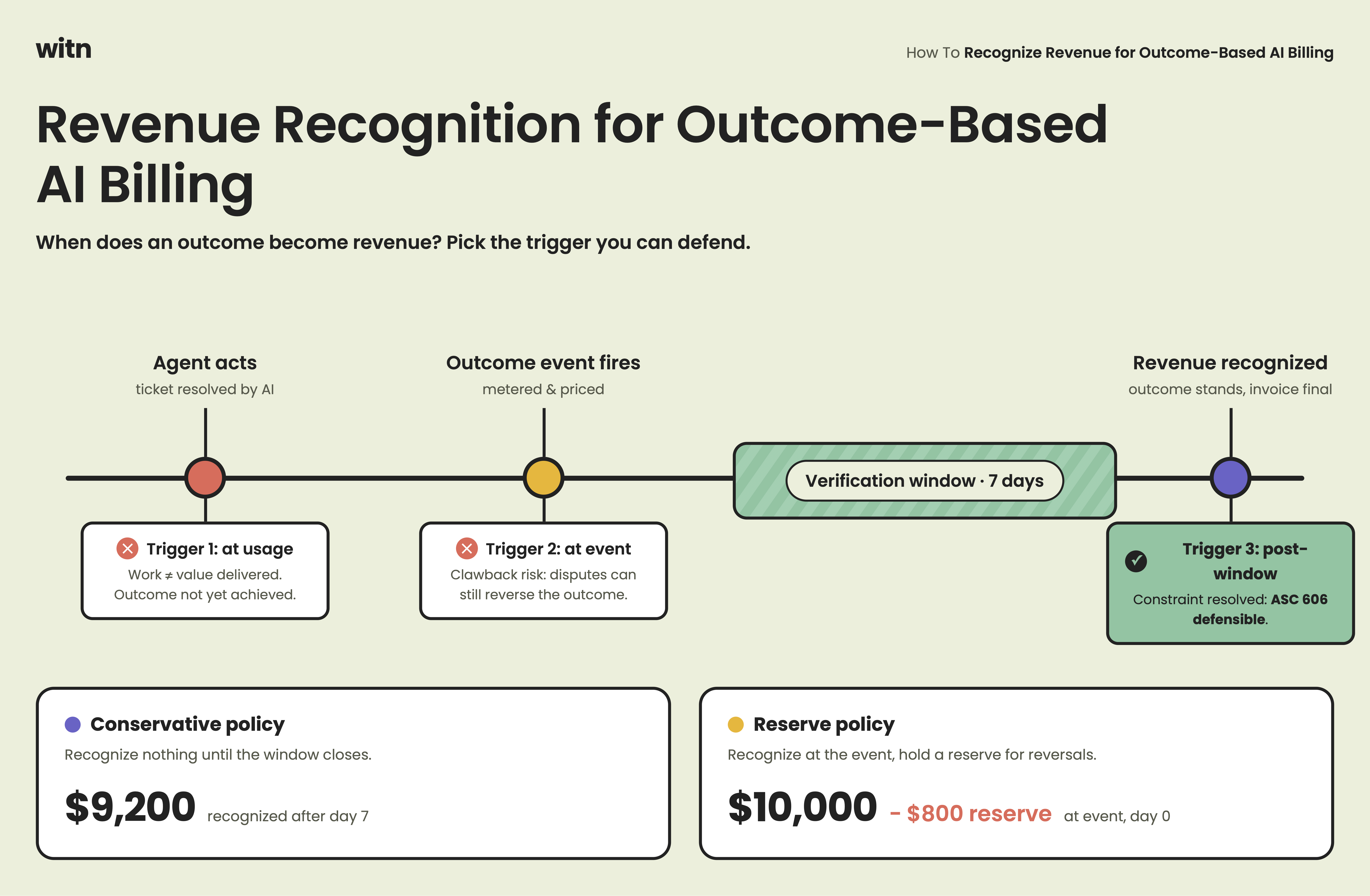
First is the moment the agent acts. For our support agent this might be when it closes a ticket in the help desk. This is the earliest possible trigger but it is also the weakest. The agent's action does not guarantee the customer received the value they paid for. The user might immediately reopen the ticket because their issue was not actually solved. Recognizing revenue at this stage is premature because the value has not been confirmed.
A second and better option is the moment an outcome event fires. This could be a ticket_resolved event sent from your system. This is an improvement because it represents a specific milestone. However it still may not reflect the full contractual reality. Your customer agreement likely includes a window for reversals or disputes. For example a ticket might be considered resolved only if it is not reopened within seven days. Before that window closes the value is not final.
This leads to the third and most defensible trigger: the moment the outcome survives its verification window. Revenue for our $1.00 resolution is recognized only after the seven day period passes without a reopen. This is the correct approach because until that point the consideration is still variable and subject to reversal. Under ASC 606, revenue cannot be recognized until it is "probable" that a significant reversal will not occur. Aligning revenue recognition with the delivery of confirmed value is the foundation of a clean, defensible process.
Variable consideration and the constraint
Reopened tickets, cancelled bookings and reverted work are all forms of variable consideration under ASC 606. The standard requires you to estimate the amount of revenue you will ultimately receive and it includes a "constraint". You can only recognize revenue to the extent that it is probable a significant reversal will not occur later. This leaves you with two accepted treatments.
The first is the conservative policy. You recognize revenue only after the outcome is fully confirmed and no longer subject to reversal. In our example the agent produces 10,000 resolutions in a month. Your contract has a seven day verification window and historical data shows an 8 percent reopen rate. Under this policy you recognize each resolution as its window closes. Of the 10,000 resolutions, 8 percent reopen and never become billable. You recognize the remaining 9,200 for a total of $9,200, with resolutions from the last week of the month confirming in the following month.
The second option is the reserve policy. You recognize revenue at the initial outcome event but you simultaneously book a reserve for expected reversals. Using our example you would recognize the full $10,000 in revenue when the 10,000 tickets are resolved. At the same time you would book an $800 liability, 8 percent of $10,000, as a reserve for future reversals. This requires a reliable estimate of your reversal rate, which you can refine by following a structured process. You can learn more in our guide on How to Test Your Outcome Pricing Model Before Launch.
Both methods are valid under ASC 606 and the equivalent IFRS 15 rules. They arrive at the same economic result over time. The choice depends on your company's operational maturity and risk tolerance.
| Metric | Conservative policy | Reserve policy |
|---|---|---|
| Timing of recognition | At verification window close | At initial outcome event |
| Audit burden | Lower. Evidence is binary | Higher. Requires estimation and defense of the rate |
| Revenue smoothness | Lumpier. Follows settlement lag | Smoother. Aligns with activity |
Hybrid models: platform fee plus outcomes
Many AI agent companies use a hybrid pricing model that combines a recurring platform fee with per outcome charges. This structure is fully compatible with ASC 606 but it requires you to treat the components correctly. The platform fee and the outcome charges are typically considered two distinct performance obligations.
The revenue recognition for each follows a different path. The platform fee is straightforward. It is recognized ratably over the subscription term just like a standard SaaS contract. A $12,000 annual platform fee would be recognized at $1,000 per month.
The outcome charges are treated as variable consideration and must follow the policy you chose in the previous section, either the conservative or the reserve method. The key complication arises when you offer a bundled discount on the entire contract. If a customer gets a discount for signing up for both the platform and the outcomes, that discount must be allocated across both performance obligations. This means you must allocate a portion of the discount to the platform fee and a portion to the estimated outcomes you expect to deliver over the contract term. This requires careful modeling at the contract's inception to avoid complex reallocations down the line.
What auditors will ask for
When it comes time for an audit, your auditors will not accept aggregate usage numbers as sufficient evidence for recognized revenue. They will need to see proof that each dollar corresponds to a specific, contractually defined and verified performance obligation. To prepare for this you must be ready to provide a detailed evidence trail for every single outcome you bill for.
Auditors will demand specific per outcome evidence including:
- An immutable event log showing the entire lifecycle of each outcome.
- Precise timestamps for when the outcome was initially triggered and when its verification window officially closed.
- A clear and demonstrable link from every single invoice line item back to its source events.
This level of granularity is non-negotiable for a clean audit. It is the only way to prove that your outcome accounting is accurate and defensible. An auditor should be able to pick any line item on any invoice and trace it back to the raw event data that proves a performance obligation was satisfied. This granular evidence trail is also your best defense against billing disputes. You can read more about this in our guide on How Transparent Invoicing Stops AI Billing Disputes.
Operational requirements this puts on your billing system
Supporting this rigorous accounting framework places specific demands on your billing infrastructure. A simple subscription billing system is not equipped to handle the complexities of outcome-based models. Your billing layer must be able to track each individual outcome through a distinct lifecycle from a provisional state to a confirmed or failed state. It needs to timestamp every state transition and maintain an append only event history that can serve as an audit log. witn is designed for exactly this purpose. It models this outcome lifecycle natively, holds each outcome in a provisional state through a configurable settlement window and then confirms or fails it automatically, creating a complete auditable event log behind every invoice line. This capability is the missing piece we describe in The Missing Layer in AI Agent Monetization.
A closing checklist for your accountant
Outcome-based pricing does not have to create accounting headaches. With the right framework and systems you can achieve clean, auditable revenue recognition. Here is a simple checklist to bring to your next meeting with your accountant or auditor to structure the conversation and establish a clear policy.
- Define the performance obligation as the verified outcome. Be explicit that revenue is earned on a confirmed result, not on agent activity.
- Write the verification window into the contract. Your customer agreements must clearly state the criteria and time period for an outcome to be considered final.
- Pick a recognition policy and apply it consistently. Decide whether you will use the conservative policy or the reserve policy for variable consideration and stick with it.
- Keep per outcome evidence. Ensure your billing system can provide the granular, auditable evidence trail that auditors will require for every single charge.
- Review reversal rates quarterly. If you use a reserve policy, plan to regularly review and update your estimates for reversal rates based on the latest historical data.
By following these steps you can build a robust process for revenue recognition that satisfies your auditors and allows your company to scale its pricing model with confidence.
The complete monetization playbook

How to price, verify and bill the work your AI agent delivers. A practical playbook for founders, product leads and engineers, from choosing a pricing model to operating outcome-based billing in production. 17 pages, free download.
witn vs Stripe
An honest comparison of witn and Stripe for AI agent billing. Where usage metering fits, where outcome resolution wins and how to combine them in one stack.
A Buyer's Guide to Outcome-Based AI Pricing
A practical playbook for buying outcome-based AI agents. What to ask vendors, what to demand in the contract and how to compare quotes on equal terms.