AI Agent Pricing in 2026: Fin, Sierra, Decagon
Real 2026 AI agent pricing from Fin, HubSpot and Salesforce. Calculate the true cost per successful resolution to choose vendors wisely.
By George Kats
Understanding the AI Agent Pricing Maze
The 2026 market for AI customer support agents is crowded. Vendor pricing models are complex and often opaque. Headline rates per resolution, per conversation or per session rarely tell the whole story. A buyer comparing a pure outcome-based fee with a hybrid platform plus usage model is not comparing like for like. This creates significant challenges for businesses trying to forecast costs and evaluate return on investment.
This article provides a practical, numbers-driven survey to help buyers and founders navigate this landscape. We will examine the reported pricing structures of major vendors. Then we will demonstrate how to normalize these different models into a single metric. The goal is to equip you to build a cost model for your own ticket volume and make a truly informed decision.
A Survey of Current AI Agent Pricing Models
To understand the market, you must first understand the individual pricing shapes. Vendors structure their fees to align with their product strategy, whether that is pure performance, a platform defense or an enterprise service bundle. Here is a survey of the most common models and reported rates in 2026.
Fin by Intercom: The Pure Outcome Benchmark
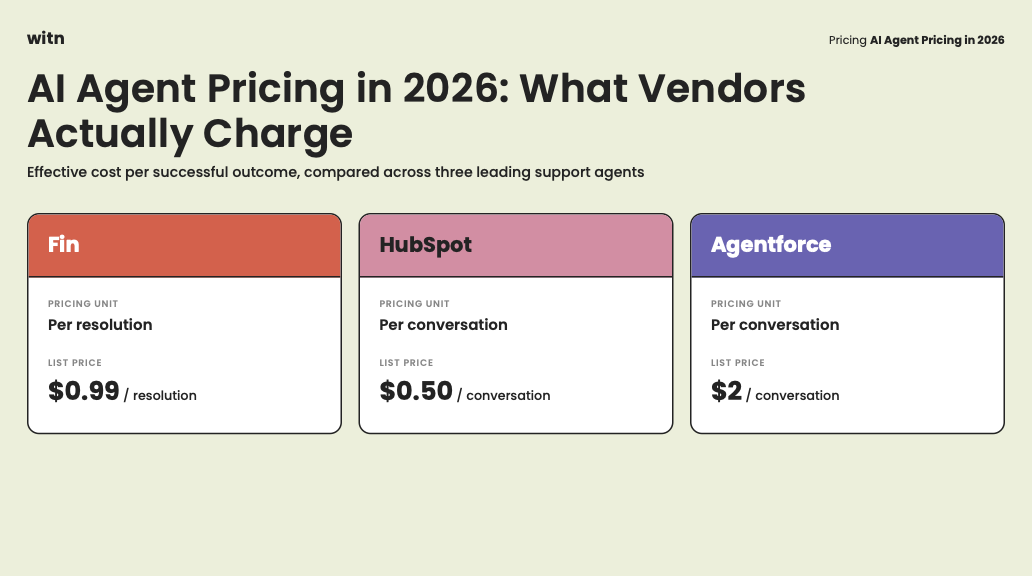
Fin is the market's reference point for pure outcome-based billing. The reported cost is a flat $0.99 per resolution with no accompanying platform fees or per-seat charges. It operates over an existing helpdesk. This simplicity is appealing but the definition of "resolution" is critical. Intercom has cited an average resolution rate around 71 percent across its customer base. However, independent reports often place the figure between 42 and 50 percent. This gap is not about performance but about what counts as a resolved ticket.
HubSpot Customer Agent: The Aggressive Suite Play
HubSpot's strategy reflects its position as a platform giant. The Customer Agent price was cut to $0.50 per resolved conversation in April 2026. This aggressive price point is designed to defend and expand its ecosystem. HubSpot can afford to subsidize its AI agent as a feature that makes its core CRM and service platform stickier. For buyers already invested in the HubSpot suite, this pricing is highly compelling. For others, it highlights how platform vendors use AI agents as a strategic lever rather than a standalone profit center.
Salesforce Agentforce: The Per-Conversation Model
Agentforce charges a reported $2.00 per conversation, not per resolution. This means buyers pay for every interaction the agent handles regardless of the outcome. You pay for successful resolutions and you pay for failures that require human escalation. The financial risk shifts from the vendor to the buyer. To compare this model, you must calculate an effective resolution cost. Assuming a 60 percent resolution rate, that $2.00 per conversation becomes an effective $3.33 per successful resolution.
Sierra: The Enterprise Outcome Contract
Sierra targets large enterprises with custom per-resolution contracts. The pricing is not public but reported figures suggest annual commitments around $150,000. These contracts often include substantial implementation fees ranging from $50,000 to $200,000. Deployments are also significant projects running from three to seven months. This model bundles the software with extensive professional services, minimum commitments and bespoke success definitions. It represents outcome pricing at enterprise scale, where the contract is as important as the technology.
Decagon: The Hybrid Platform Fee Model
Decagon represents a hybrid approach. Its structure reportedly combines a significant annual platform fee around $50,000 with a custom per-conversation or per-resolution rate. At least one publicly discussed contract used a rate of $0.50 per resolution on top of the platform fee. This model gives the vendor a stable revenue floor while still tying a portion of the cost to performance. For buyers, it means a higher upfront commitment but potentially lower variable costs at scale compared to pure per-conversation models.
Other Usage-Based Models
Below the outcome-focused vendors sits a tier of usage-based pricing. Freshdesk, for example, offers session-based bots with costs that can work out to roughly $0.10 per session. This model anchors the low end of the market. It bills for activity, not results. While the unit cost is low, the total cost can be unpredictable and disconnected from the value delivered. These models are often a starting point for companies before they graduate to more sophisticated outcome-based AI agents.
How to Normalize Costs for True Comparison
Headline rates are misleading. To compare these different models, you must convert them all to a single metric: the effective cost per successful resolution. This normalization requires you to model costs using your own operational data, specifically your monthly conversation volume and expected AI resolution rate.
Let us walk through a concrete example. Imagine a business handles 10,000 support conversations per month and anticipates a 60 percent resolution rate from an AI agent. This means the agent is expected to successfully resolve 6,000 conversations each month. Using this scenario, we can calculate the effective monthly cost and cost per successful resolution for each pricing shape.
The table below shows how the math works out. It reveals that the rank order of vendors by cost changes dramatically once you normalize their pricing to a common denominator.
| Pricing Model | Unit Cost | Effective Resolution Cost (60% Rate) | Monthly Total (10k Conv) |
|---|---|---|---|
| Per-Resolution | $0.99 | $0.99 | $5,940 |
| Per-Conversation | $2.00 | $3.33 | $20,000 |
| Hybrid | $0.50 + $50k/yr | $1.19 | $7,167 |
| Per-Session | $0.10 | $0.17 | $1,000 |
Note: Calculations are based on a scenario of 10,000 monthly conversations and a 60% successful resolution rate. The Hybrid model's annual fee is amortized monthly ($4,167/mo). These figures illustrate how headline rates can be misleading without normalization.
The key insight is clear. The "cheapest" vendor depends entirely on your volume and performance assumptions. A per-session model looks inexpensive on a unit basis but a per-resolution model might offer more value predictability. You must run the numbers for your own business to see the true cost of each option.
The Critical Caveat: Defining "Resolution"
Even a perfectly normalized cost comparison has a major weakness. The calculation is only valid if every vendor defines "resolution" in the same way. They do not. The contractual and technical definition of the billable event is the single most important variable in your final cost. A seemingly small difference in this definition can swing your effective cost by 30 to 50 percent. When evaluating vendors, you must scrutinize the fine print. Pay close attention to the specific event that triggers a billable resolution, the length of the reopen window before a follow-up is considered a new ticket and how partial resolutions or escalations are handled. We took this fine print apart in What Counts as a Resolution?. Your financial model is only as accurate as these definitions.
Market Pressures and the Future of Vendor Differentiation
The current AI agent pricing landscape is shaped by intense market pressures. The $0.99 per resolution price point is becoming a psychological anchor for the industry. Aggressive price cuts like HubSpot's signal commoditization pressure at the lower end of the market, where basic agent capabilities are becoming table stakes. In response, sophisticated vendors are shifting their differentiation from the rate card to the contract. As highlighted by industry analysis from Corebee.ai, premium pricing is no longer justified by the AI model alone. Instead, it is justified by stricter resolution definitions, longer reopen windows and fully auditable invoices that give buyers confidence in what they are paying for. The future of competition is in the clarity and fairness of the billing logic.
Building for an Outcome-Based World
This shift toward auditable outcome-based billing creates new technical challenges for vendors. Defining what counts as a resolution, holding charges through settlement windows and producing invoices that buyers can trust requires specialized infrastructure.
These benchmarks are one input into a bigger decision. We map the full journey from pricing model to production billing in AI Agent Monetization: The Complete Guide.
witn is billing infrastructure built for exactly this. Express your resolution definition as a condition over events. Hold charges through settlement windows until reversals clear. Give buyers invoices where every line traces back to its proof. Read the docs to see how it works.
The complete monetization playbook
How to price, verify and bill the work your AI agent delivers. A practical playbook for founders, product leads and engineers, from choosing a pricing model to operating outcome-based billing in production. 17 pages, free download.
AI Agent Monetization: The Complete Guide
How to monetize an AI agent in 2026. Pricing models compared, billable outcomes, risk tiers, backtesting, settlement and invoicing in one complete guide.
How to Test Your Outcome Pricing Model Before Launch
De-risk your move to outcome-based billing. This guide shows AI agent builders how to simulate pricing against historical data and forecast revenue.