Why Per-Minute Billing Is a Trap for Voice AI
Why per-minute billing traps voice AI companies. How outcome-based pricing aligns incentives with the value you deliver.
By George Kats
Voice AI has delivered a genuine breakthrough for countless industries, making 24/7 multilingual phone support and outbound campaigns at scale a practical reality. This technological leap has unlocked immense value. Yet the way most companies charge for it is fundamentally broken, creating a trap that punishes innovation.
The Genuine Breakthrough of Voice AI
Before we examine the pricing dilemma, it is important to acknowledge what a significant achievement voice AI represents. It is not an incremental improvement. It is a technology that has made entirely new operational models possible for businesses.
For the first time, companies can offer true 24/7 phone coverage without the complexities of overnight staffing. They can provide instant, scalable support in dozens of languages, a feat that was previously prohibitively expensive and logistically impossible for all but the largest global enterprises. This technology also dramatically improves accessibility, offering a vital channel for users who cannot or prefer not to type.
From handling routine customer inquiries to running outbound sales campaigns at scale, voice AI has solved real, tangible problems. It has created enormous value for both businesses and their customers. The core issue is that current voice AI pricing models fail to reflect this value accurately.
The Misalignment of Flat-Fee Licensing
A common starting point for pricing is the flat-fee license. Its appeal is its simplicity. A customer pays a fixed price for access to the platform for a set period. While predictable, this model is completely disconnected from the value the AI agent delivers.
This creates a two-sided problem. A buyer with low call volume inevitably overpays, spending money on capacity they do not use. Conversely, a vendor with a high-usage customer is guaranteed to be underpaid, as their revenue is capped regardless of how much work their agent performs. The vendor's upside is severed from their customer's success.
This value disconnect makes renewal conversations notoriously difficult. The vendor cannot point to specific outcomes to justify the fee and the buyer feels the price is arbitrary. The discussion becomes adversarial, centered on discounting the cost rather than celebrating the value created. It is a pricing structure that puts both parties on opposing sides of the table from day one.
The Self-Defeating Logic of Per-Minute Billing
The most dominant model today is per-minute metering. On the surface, it seems like a fair, usage-based approach. The customer pays for what they use. The fatal flaw, however, is that it meters the wrong thing. It measures cost, not value. This creates a series of per-minute billing problems that actively undermine product improvement.
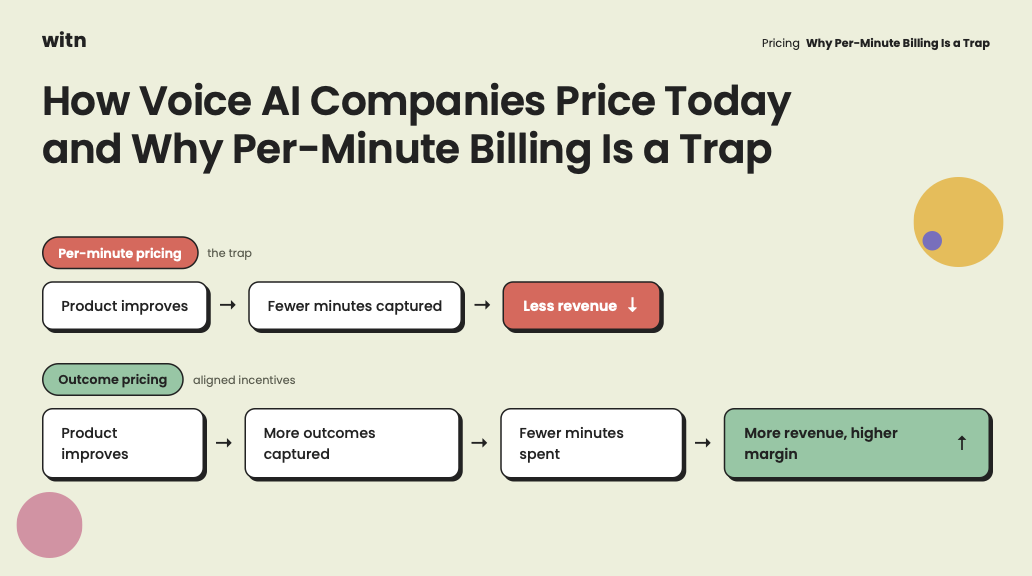
Consider this scenario. Your engineering team works for months to improve your voice agent. They fine-tune the dialogue design, reduce system latency and deploy a faster language model. As a result, the average call resolution time drops from six minutes to three. You have just made your product twice as good for your customer. You have also just cut your revenue in half.
This is the per-minute trap. Your product roadmap and your revenue goals are pulling in opposite directions. Every successful engineering sprint that makes your agent more efficient directly shrinks your top line. You are financially penalized for innovation. We covered this dynamic in depth in Why Your AI Product's Success Could Shrink Your Revenue.
This problem is compounded by what can be called "revenue leakage". The underlying costs of AI, such as LLM inference and text-to-speech services, are constantly falling. This puts continuous downward pressure on per-minute rates across the industry. As an analysis from TCHB highlights, this model essentially punishes vendors for their own engineering progress. Your revenue erodes even if your call volume remains steady, forcing you to run faster just to stand still.
An Overview of Current Pricing Alternatives
Recognizing these flaws, some companies have experimented with other models. However, most are simply variations on the same theme and carry their own trade-offs. They represent compromises, not solutions.
Per-conversation flat rates offer predictability but fail to account for call complexity. A simple password reset is billed the same as a complex troubleshooting session, meaning price and value remain disconnected. Concurrency-based pricing, where customers pay for a set number of simultaneous lines, meters capacity instead of results. This is inefficient for businesses with fluctuating demand, forcing them to pay for idle capacity during off-peak hours.
Hybrid models that combine a platform fee with usage charges attempt to find a middle ground. Yet they often inherit the weaknesses of both approaches, especially when the usage component is still metered per minute. The fundamental misalignment between efficiency and revenue persists.
The table below summarizes how these common pricing models stack up when it comes to aligning vendor incentives with customer value.
| Pricing Model | Incentive Alignment | Buyer Predictability | Value Capture |
|---|---|---|---|
| Flat-Fee License | Poor (Disconnected from value) | High (Fixed cost) | Poor (Caps vendor upside) |
| Per-Minute Metering | Negative (Penalizes efficiency) | Low (Cost varies with duration) | Poor (Meters cost, not value) |
| Concurrency-Based | Poor (Prices capacity, not usage) | Medium (Fixed for capacity) | Poor (Unrelated to results) |
| Outcome-Based | High (Tied to business results) | Medium (Cost varies with success) | High (Directly maps to value) |
The Customer Support Precedent for Outcome Pricing
The path forward for voice AI is not theoretical. It has already been paved by an adjacent industry: customer support software. For years, support tools were sold based on agent seats or ticket volume. This created familiar misalignments. Vendors were incentivized to encourage more seats or tickets, not better or faster resolutions.
The market eventually shifted to outcome-based pricing, specifically "per-resolution" models. Buyers embraced this change because it mapped the price directly to the one thing they cared about: a solved customer problem. The incentive for the vendor became to resolve issues as efficiently as possible, perfectly aligning their success with their customer's goals.
Voice AI sits right next to this market, often handling the very same support interactions. The migration path is clear. The future of voice AI pricing is charging for successful business outcomes. This model can be applied across every major use case:
- Support: Charge per successfully resolved call.
- Sales: Charge per qualified lead or booked meeting.
- Scheduling: Charge per confirmed appointment.
- Collections: Charge per completed payment.
This is the only model where the vendor and the customer both win when the product gets better.
The Operational Shift to Outcome-Based Billing
If outcome-based pricing is the obvious solution, why has it not been widely adopted? The answer is that it is operationally much harder than running a simple minutes meter. Making this shift requires real billing infrastructure, not a counter.
Successfully implementing this model requires several key capabilities:
- Defining the outcome. You need a precise, machine-readable definition of what constitutes a "booked appointment" or "resolved issue". Our guide on billable conditions shows how to express these definitions.
- Verifying the outcome. This definition must be verifiable through event data from other systems, like a CRM update or a calendar API call, not subjective interpretation.
- Handling complexity. The system must manage reversals and settlement windows. What happens if a booked appointment is cancelled a day later? We explored this in Pricing AI Outcomes as Risk Contracts.
- Ensuring auditability. The buyer needs a clear, auditable trail that connects every single charge on their invoice back to the specific outcome that generated it. Transparent invoicing is what makes outcome pricing defensible.
These requirements are not trivial, but they are essential for building a monetization strategy that scales with customer value.
Align Revenue With Product Improvement
Moving from per-minute metering to outcome-based billing aligns your revenue model with your product innovation. It ensures that as you make your voice agent better, faster and more efficient, your business grows alongside your customers' success.
witn is billing infrastructure built for exactly this. Define the outcome as a condition. Send events as the agent works. The charge settles when the condition holds through the settlement window and every invoice line traces back to the calls that earned it. Read the docs to see how it works.
The complete monetization playbook

How to price, verify and bill the work your AI agent delivers. A practical playbook for founders, product leads and engineers, from choosing a pricing model to operating outcome-based billing in production. 17 pages, free download.
Building witn's Low-Latency Outcome Resolution Layer
Explore the engineering of a low-latency, high-reliability outcome resolution layer for AI agent billing. Learn how we solved for correctness and scale.
How Transparent Invoicing Stops AI Billing Disputes
Reduce billing disputes and lower support costs for your AI product. This guide shows how to build transparent, self-explanatory invoices that earn trust.