A Buyer's Guide to Outcome-Based AI Pricing
A practical playbook for buying outcome-based AI agents. What to ask vendors, what to demand in the contract and how to compare quotes on equal terms.
By George Kats
The Promise and Pitfalls of Paying for Results
In 2026, a growing share of AI agent vendors price on outcomes. This model is attractive because it promises to align your costs with the value you receive. Instead of paying for seats or minutes, you pay for successful results. For buyers tired of investing in technology with uncertain returns, this feels like a safer bet. It shifts the performance risk from you to the vendor.
However, this safety is not automatic. The entire model hinges on a single, critical detail: the definition of a "result". A vague or vendor-friendly definition can quickly turn a seemingly fair deal into a source of unpredictable and inflated invoices. The promise of paying for performance is only as good as the contract that defines it. Understanding this is the first step to making a smart purchase. The goal of outcome-based pricing is to pay for value, but you must first define what value means in clear, measurable terms.
Defining the Billable Outcome
When evaluating an AI agent, the first and most important question to ask a vendor is, "What exactly counts as a billable outcome?". Their answer reveals everything about the financial partnership you are about to enter. A "resolution" is not a universal standard. Its definition varies significantly from one vendor to another. This difference has a direct impact on your final bill.
Vendors often define a successful resolution in one of several ways:
- Explicit confirmation. The user must click a "My issue is resolved" button or give a similar positive confirmation. This is the most buyer-friendly definition.
- No user reply. The conversation is considered resolved if the user does not reply within a set time frame, such as 48 or 72 hours. This can be problematic as users may simply get busy or give up.
- No reopen. A ticket is marked resolved and is only billed if it is not reopened by the user within a specific window, like seven days.
Consider the financial implications. Imagine your team handles 1,000 support tickets. A vendor using an "explicit confirmation" rule might find that 450 of those tickets are billable. Another vendor using a "no reply for 72 hours" rule might claim 700 resolutions from the exact same ticket volume. That is a 55 percent difference in cost for the same work. This is often why vendor-cited resolution rates of 70 percent or more rarely match the 40 to 50 percent rates buyers observe in practice. The gap comes from definitions, not just performance. For a deeper look into this, we have analyzed what counts as a resolution in the fine print of these agreements.
Normalizing Quotes to a Single Metric
Comparing AI agent pricing models can feel like comparing apples to oranges. One vendor charges per conversation, another per resolution and a third uses a hybrid model with a platform fee. To make an informed decision, you must translate every quote into a single, universal metric: the effective cost per successful outcome. This calculation cuts through the marketing and reveals the true cost of getting a job done.
Let's walk through an example. Assume you handle 10,000 conversations per month and your historical data suggests a realistic successful resolution rate of 45 percent. This means you expect 4,500 successful outcomes.
Here is how to compare three common pricing structures:
- Vendor A (per conversation). Charges $2.00 per conversation, like Salesforce Agentforce. Your total cost is 10,000 conversations × $2.00, which equals $20,000. To find the effective cost per successful outcome, you divide the total cost by the number of successful outcomes: $20,000 / 4,500 = $4.44 per success.
- Vendor B (per resolution). Charges $0.99 per resolution, similar to Fin by Intercom. Here, the price per resolution is already the effective cost. Your total bill would be 4,500 successful outcomes × $0.99, which equals $4,455. The effective cost is $0.99 per success.
- Vendor C (hybrid). Charges a $2,000 monthly platform fee plus $0.50 per resolved conversation, like HubSpot Customer Agent. Your cost is the platform fee plus the usage fee: $2,000 + (4,500 × $0.50) = $4,250. Your effective cost is $4,250 / 4,500 = $0.94 per success.
| Model | Pricing structure | Total monthly cost | Effective cost per successful outcome |
|---|---|---|---|
| Vendor A (per conversation) | $2.00 per conversation | $20,000 | $4.44 |
| Vendor B (per resolution) | $0.99 per resolution | $4,455 | $0.99 |
| Vendor C (hybrid) | $2,000 platform fee + $0.50 per resolution | $4,250 | $0.94 |
Calculations assume a 45 percent successful resolution rate. That is 4,500 successful outcomes out of 10,000 conversations. This normalization reveals the true cost of a successful result across different models.
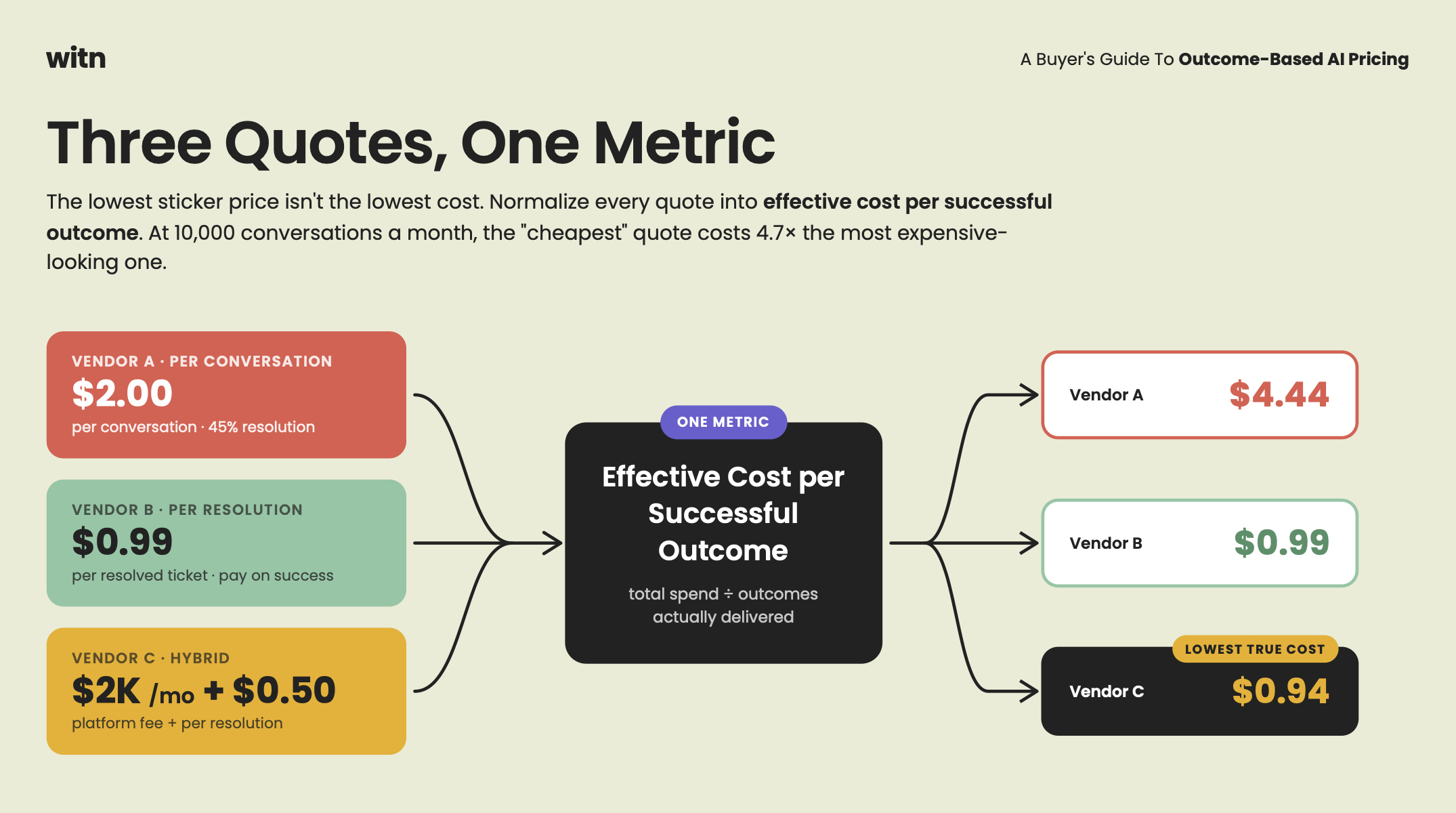
This simple exercise is essential for any serious evaluation. It is the only way to see which model is truly the most cost effective for your specific needs. For more examples, see our breakdown of AI agent pricing in 2026 and what major vendors actually charge.
Your Contract Fine Print Checklist
Once you have normalized quotes, the next step is negotiating the contract. The sales deck is not the contract. You must ensure all verbal promises and definitions are written into the legal agreement. An experienced procurement leader would never sign a deal without clarifying these points. Use this checklist to protect your business from surprise invoices and unfair terms.
- Reopen windows. The contract must clearly define the time period during which a customer reopening a ticket does not trigger a new billable event. Demand a window of at least 7 to 14 days.
- Verification and audit rights. You must have the right to audit the vendor's billing data. This ensures you can independently verify that you are only being charged for valid outcomes.
- Dispute process. What happens when you disagree with a charge? The contract needs a clear, simple process for disputing line items, including response timeframes from the vendor.
- Volume commitments. Be wary of high minimum monthly commitments or steep penalties for falling below a certain volume. The contract should also specify pricing for overages.
- Human escalation. The contract must state what happens when the agent fails and escalates to a human. Is there a charge for the failed attempt? Is the escalation itself a billable event? Get this in writing.
How to Run a Fair Pilot Program
A pilot program is not just for testing the technology. It is your best opportunity to validate the vendor's pricing model and performance claims in a controlled environment. A well-structured pilot provides the data you need to make a final decision.
First, establish your baselines before the pilot begins. You need to know your current metrics, including your human team's cost per resolution, average resolution time and customer satisfaction scores. Without this data, you have nothing to compare the agent's performance against.
Second, prevent cherry-picking. Insist that the AI agent is tested on a representative sample of all incoming tickets, not just the easy, repetitive ones the vendor prefers. The agent must be exposed to the same complexity and variety your human team faces.
Third, set an adequate duration. A one week pilot is not enough to generate meaningful data. A pilot should run for at least 30 to 60 days to account for fluctuations in ticket volume and complexity.
Finally, define pass criteria upfront. Before the pilot starts, agree with the vendor on what success looks like. This should be a specific, measurable goal. For example, "The agent must achieve an effective cost per successful outcome below $1.50 while maintaining a CSAT score of 90 percent or higher". This removes ambiguity and makes the final evaluation straightforward.
Red Flags to Watch For
During your evaluation, certain practices should be considered serious red flags. These warning signs often indicate a lack of transparency that will lead to billing disputes and frustration down the line. If you encounter any of these, proceed with extreme caution.
- No per-outcome evidence. If a vendor bills you for 500 "resolutions" but cannot provide a list of the 500 specific conversations that were resolved, their bill is unverifiable. You should be able to trace every single charge back to a source event.
- Opaque definitions. Be wary if a billable outcome is defined by a proprietary, black-box metric that only the vendor can measure. If you cannot independently calculate or verify an outcome, you cannot audit your invoices.
- Aggregate invoices. An invoice that arrives as a single number, like "$5,000 for services rendered", is unacceptable. It hides all the important details, making it impossible to check for accuracy or understand cost drivers.
These issues are common, but they are also solvable. They are symptoms of an outdated billing system that is not designed for the nuance of outcome-based models. You can learn more about how transparent invoicing stops AI billing disputes and what to demand from your partners.
What a Good Partnership Looks Like
A good vendor partnership is built on transparency and trust. It moves beyond sales claims and into shared, verifiable data. In an ideal relationship, the vendor's success is directly and transparently tied to your own.
This is what good looks like in practice. Invoices are not just summaries. They are detailed reports where every single line item links back to a verifiable event, such as a conversation transcript or a completed action. The definitions for billable outcomes are not hidden in a sales deck. They are written clearly into the contract in plain language. The best vendors go a step further, offering shared dashboards that provide near real-time visibility into how outcomes are being measured and billed. This eliminates surprises at the end of the month.
This level of detail and transparency is entirely possible with a modern billing layer. For example, platforms like witn are built to produce invoices with linked evidence for every charge, giving both the buyer and the seller a single source of truth. When you evaluate vendors, look for those who have invested in this level of clarity. It is the clearest sign of a partner you can trust.
Questions to Ask Your AI Vendor
Copy this list into your notes for your next vendor call.
- What is your precise definition of a billable "outcome" or "resolution"?
- Can you show me where that definition is written in the contract?
- What is the reopen window for a resolved ticket?
- How do you handle conversations that are escalated to a human agent?
- Can I get a sample invoice that shows line-item level detail for each charge?
- How do I audit or dispute a specific charge on my invoice?
- What are your minimum commitments and overage rates?
- During a pilot, how will you ensure the agent is tested on a representative sample of tickets?
- What baseline metrics do you recommend we capture before starting a pilot?
- Can you provide a shared dashboard for tracking billable outcomes in real time?
The complete monetization playbook
How to price, verify and bill the work your AI agent delivers. A practical playbook for founders, product leads and engineers, from choosing a pricing model to operating outcome-based billing in production. 17 pages, free download.
Revenue Recognition for Outcome-Based AI Billing
Learn how to apply ASC 606 to outcome-based AI billing. This guide for finance leaders offers a framework for clean revenue recognition and audit readiness.
Defining Concrete Billable Outcomes for AI Agents
Learn to define concrete, defensible billable outcomes for AI agents. Move past usage metrics to simple, auditable events that price what customers value.