Monetizing AI Agents: From Seats to Outcomes
A decision framework for AI agent monetization. Choose between seat, usage, workflow and outcome-based models to align pricing with value.
By George Kats
The Spectrum of AI Monetization
While recent analysis shows that a vast majority of AI companies use some form of hybrid pricing, the real strategic decision lies in designing the variable component of that model. For founders and product leads with a working agent, the path to effective monetization is an evolutionary process. It is not a static choice made once at launch. The journey is about maturing from pricing based on your internal costs to pricing based on the tangible value your agent delivers to the customer.
Choosing the right strategy is not about picking the most popular model. It is about an honest assessment of your agent's current capabilities and your business's operational readiness. The correct approach depends on two fundamental factors. First, how precisely can you define and verify the outcome your agent produces? Second, how much delivery risk is your company prepared to absorb as the agent learns and improves? Answering these questions provides a clear path toward aligning your price with your agent's impact.
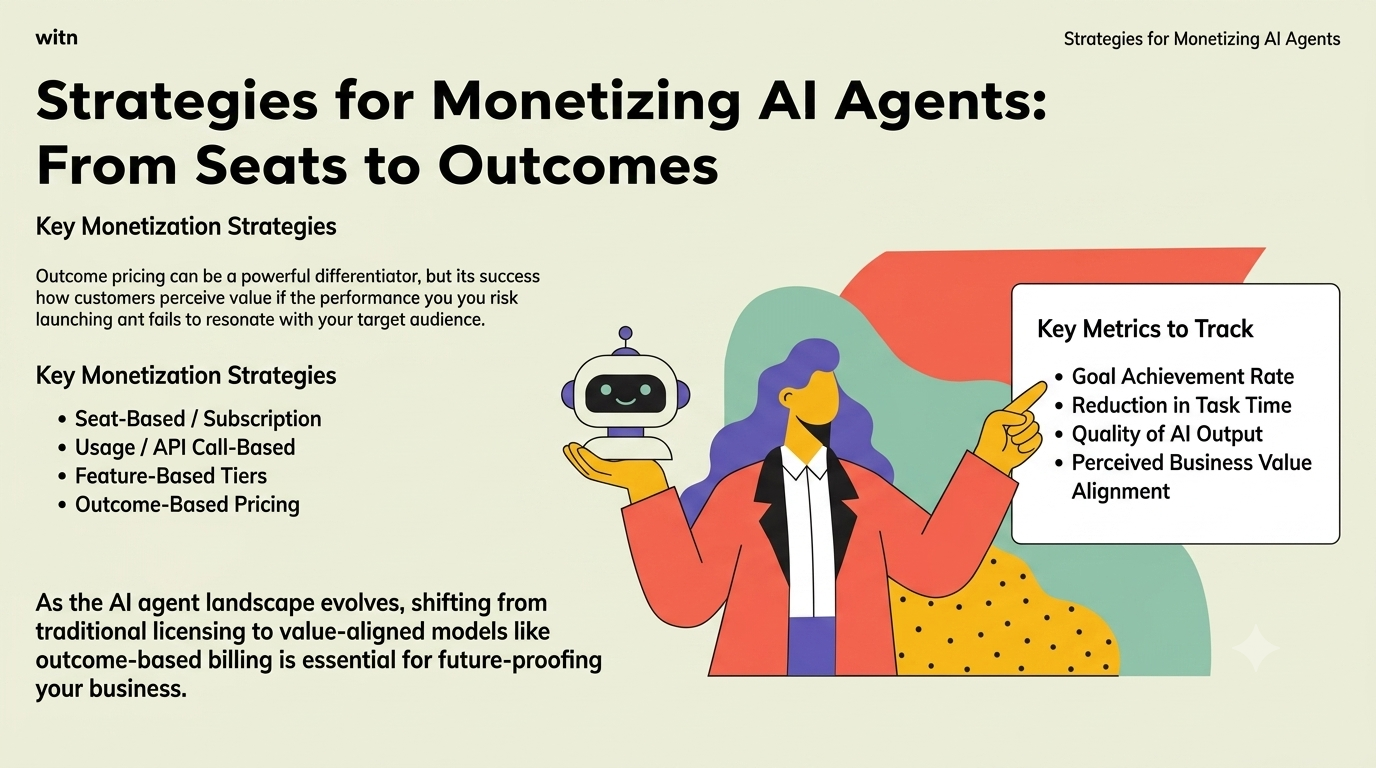
Seat and License Pricing for Human Augmentation
The most familiar model is seat-based pricing, often framed as a direct replacement or augmentation of a full-time employee (FTE). You price the agent against the human it assists. This approach works exceptionally well for copilots, where the agent is tethered to a specific human user. Think of a sales copilot that helps an account executive draft emails or a developer assistant that suggests code within an IDE. The value is contained within that user's workflow, making a per-seat license a logical and easy-to-sell metric.
However, this model's logic quickly unravels when applied to autonomous agents. When an agent works independently across an entire organization, handling tasks 24/7 without a dedicated human operator, the concept of a "seat" becomes arbitrary. It no longer maps to value. Charging per seat for an autonomous customer service agent that handles thousands of conversations is like charging a factory per lightbulb instead of per widget produced. The metric fails to scale with the agent's true contribution.
Usage and Consumption Based Pricing
Consumption pricing is the bedrock of many developer-facing APIs, charging per token, API call or minute of processing time. Its primary strength is its transparency and simplicity. Customers can clearly see the link between their activity and their bill, which builds trust and is easy to meter. For businesses, it directly ties revenue to infrastructure costs, creating a straightforward financial model. This is often the default starting point for new agent platforms.
The fundamental flaw, however, is that this model prices your cost, not your customer's value. It creates a difficult misalignment between your product goals and your revenue goals. As your team works to make the agent more efficient, perhaps using a smarter model that requires fewer tokens to achieve the same result, you directly shrink your revenue per task. You are financially penalized for improving your product. We unpacked this dynamic in Why Your AI Product's Success Could Shrink Your Revenue. This inherent conflict makes pure consumption pricing an unsustainable long-term strategy for value-driven agents.
The Role of Credit Systems
Credit systems introduce an abstraction layer over raw consumption. Customers pre-purchase a block of credits, which are then burned based on various actions the agent performs. This model is gaining significant traction. According to a field report from Metronome, roughly a third of software companies have adopted credits, with another third planning to. For enterprise buyers, credits simplify complex, multi-vector usage into a single, predictable currency. For vendors, they improve cash flow and revenue predictability through upfront payments.
While the user experience feels friendlier than a running meter of costs, it is important to be honest about what credits often are. They are a cost-plus workaround with a better interface. The underlying issue of pricing cost instead of value can remain. This can also create a new kind of buyer anxiety. Customers often struggle to predict their credit burn rate, making it difficult to budget accurately and leading to fears of a surprise overage or wasted, expiring credits.
Pricing Completed Workflows and Tasks
A significant step up the value ladder is charging per completed workflow. Instead of billing for the granular inputs like tokens or API calls, you charge a flat fee for a finished multi-step task. This could be "one processed invoice" or "one generated social media post". The price is fixed regardless of the underlying compute resources or time taken. This model represents a strategic middle ground for many agent builders.
It moves the pricing conversation closer to the customer's business logic and away from your internal costs. It is more aligned with value than raw usage but crucially, it avoids the heavy operational burden of verifying a final business result. The primary limitation of this approach is that it confirms the agent did something, but not that the action produced the desired impact. It prices the activity, not the outcome. An agent can successfully "run a lead qualification workflow" on a junk lead and the customer is still charged.
Outcome Based Pricing Models
The highest form of value alignment is found in outcome-based pricing. Here, the customer is charged only when a predefined and verifiable business result is achieved. This is the destination for agents that can prove their impact. Concrete examples include charging only for a successfully resolved support ticket, a sales appointment that is actually booked and attended, a payment that clears or a lead that meets specific qualification criteria and is accepted by the sales team. Writing these definitions well is its own discipline, one we covered in Defining Concrete Billable Outcomes for AI Agents.
This model creates the strongest possible partnership with your customer. You only win when they win. However, this alignment comes with significant operational complexity. It is the hardest model to operate correctly. It demands robust systems for defining outcomes in machine-readable terms, verifying those outcomes from event data, managing settlement windows for reversals or adjustments and producing auditable invoices that clearly explain every charge. This complexity is precisely why a dedicated resolution layer becomes necessary.
Building Hybrid Pricing Structures
Most mature companies land on hybrid billing models. These structures typically combine a fixed component, such as a monthly or annual platform fee, with a variable component based on usage, workflows or outcomes. The appeal is clear. The fixed fee provides the vendor with a predictable revenue floor to cover base costs, while the buyer gets predictability in their core expenses. It solves the cold start problem for both sides.
But simply calling a model "hybrid" is not a strategy. The critical insight is that the strategic value of any hybrid model is determined by its variable component. That is where the opportunity for true value alignment is either won or lost. A platform fee plus a per-token charge is a fundamentally different business than a platform fee plus a charge per qualified lead. The question for founders is not "should we be hybrid?" but rather "what should our variable component be aligned to?".
A Framework for Your Decision
Choosing the right strategy for your agent today requires answering three direct questions about your product and business. Your answers will map you to the appropriate model.
- Outcome definition. Can you define the desired business result with enough precision for a machine to check it? If the outcome is ambiguous, like "improved customer satisfaction", you cannot yet build a pricing model around it.
- Outcome verification. Can you verify this outcome using event data from systems you or your customer control? If you cannot see the event that confirms a "booked meeting", you cannot bill for it.
- Risk absorption. Can your business absorb the revenue volatility if the agent's performance is inconsistent or takes time to ramp up? Pure outcome pricing means you earn nothing if the agent fails, which can be a risky proposition for an early-stage company. Structuring tiers around this risk is the subject of Pricing AI Outcomes as Risk Contracts.
If you cannot yet define or verify an outcome, you must start with usage or workflow pricing. If you can verify an outcome but have low risk tolerance, a hybrid model with an outcome component is a safer path. If you can verify outcomes and can handle the performance risk, pure outcome-based pricing offers the strongest alignment.
| Strategy | Outcome Verifiability Required | Value Alignment | Revenue Predictability (Vendor) |
|---|---|---|---|
| Seat/License | Low | Low | High |
| Usage/Consumption | Low | Low | Medium |
| Credits | Low | Low-Medium | Medium-High |
| Workflow/Task | Medium | Medium | Medium |
| Outcome-Based | High | High | Medium |
| Hybrid | Varies | Varies | High |
Creating a Path to Pricing Maturity
These strategies form a clear maturity path. Most agents will begin with simpler models like seat or usage-based pricing. As the product proves its reliability and you build trust with customers, you can evolve toward workflow and eventually outcome-based models. The key is to plan for this evolution from the beginning.
The single most important piece of advice is this: instrument for outcome events from day one, even if you are only charging for usage. Track the business results your agent is producing long before you bill for them. Doing this transforms a future pricing migration from a massive engineering project into a simple configuration change. It also allows you to backtest a new pricing model against historical data to forecast its revenue impact before you make the switch.
This framework is one stage of a longer journey. For the full path from model choice through outcome definitions, risk tiers, testing and production billing, see AI Agent Monetization: The Complete Guide.
witn is billing infrastructure built for the outcome end of this spectrum. Define outcomes as conditions, verify them from events, handle settlement and reversals and get invoices where every line traces back to the result that earned it, while running usage or hybrid models alongside as you migrate. Read the docs to see how it works.
The complete monetization playbook
How to price, verify and bill the work your AI agent delivers. A practical playbook for founders, product leads and engineers, from choosing a pricing model to operating outcome-based billing in production. 17 pages, free download.
Defining Concrete Billable Outcomes for AI Agents
Learn to define concrete, defensible billable outcomes for AI agents. Move past usage metrics to simple, auditable events that price what customers value.
Why Your AI Product's Success Can Shrink Revenue
Usage and token pricing punish AI products for getting better. Learn how outcome-based and hybrid billing align revenue with the value your agent delivers.