Defining Concrete Billable Outcomes for AI Agents
Learn to define concrete, defensible billable outcomes for AI agents. Move past usage metrics to simple, auditable events that price what customers value.
By George Kats
Focus on Simple, Tangible Agent Achievements
The first mistake teams make when they define billable outcomes is aiming for something profound. They reach for metrics like revenue influenced or pipeline generated. Those metrics sound impressive and end in attribution debates. The best billable outcomes are usually boring. They are the small, repetitive chores the customer used to handle manually. An appointment gets booked. A creative asset gets generated. A support ticket gets resolved. That is the right level of focus.
These outcomes are concrete, countable and happen hundreds of times a week, not once a quarter. Shift your mindset from abstract value narratives to demonstrable, completed work and your billing model becomes clearer for everyone. The goal is to find the smallest tangible unit of work your agent completes that still provides undeniable value. That unit is the foundation of a billing system your customers will understand and trust, because it maps directly to tasks they no longer do themselves.
The Three Core Properties of a Defensible Outcome
A billable outcome is a verifiable unit of completed work that an AI agent gets paid for. Moving from that general idea to a specific metric needs a clear test. A strong billable outcome is not just valuable. It is defensible. It has three properties that remove ambiguity and prevent disputes later.
A defensible outcome is:
- Observable. You and your customer can both point to the event and agree it happened. No subjective interpretation. A confirmed entry in a shared calendar is observable. A change in a CRM status might not be.
- Repetitive. The event happens often. When an outcome occurs hundreds of times, billing normalizes and no single charge carries much financial weight or scrutiny. Rare, high-value events invite detailed inspection.
- Hard to dispute. The outcome should be self-evident. If you need a slide deck to explain why a charge is valid, it is a value narrative, not a billable outcome. Keep the complex stories for your sales deck and the simple facts for your invoices.
This is why "appointment booked" works so much better than "pipeline created". To make it robust, the definition must include a time window. For example, an appointment only becomes billable if it is not cancelled within 24 hours. This small addition handles the edge cases and turns a billing assumption into a concrete rule.
| Property | Weak outcome: "Lead qualified" | Strong outcome: "Demo meeting booked" |
|---|---|---|
| Observability | Relies on subjective CRM status changes | Verifiable via calendar invite and acceptance |
| Repetition | Variable, depends on campaign success | Occurs consistently as part of the sales process |
| Indisputability | Attribution debates are common. Was it marketing or the agent? | The meeting is on the calendar or it is not |
| Time window | Undefined. A lead can be disqualified later | Billable if not cancelled 24 hours before start time |
Moving Beyond Usage Metrics and Credit Systems
Many AI agent builders default to familiar billing models. Usage-based pricing. Credit systems. Both are common and both often fail to capture the value an agent delivers. Charging per API call or token measures infrastructure consumption, not customer success. Your customer does not care about tokens. They care about the completed task.
Credit systems are a step in the right direction, but they are still an abstraction. They add an accounting layer between the customer and the job they hired your agent to do. A customer buys credits to generate slide decks, but what they want is finished slide decks. The credit is a unit of exchange, not the value itself. Most credit-based products already have a tangible outcome hiding just beneath the surface.
The work is to name that outcome and check whether it is solid enough to price directly. Is the agent's output observable, repetitive and hard to dispute? Often the answer is yes. Switching from selling credits to selling completed outcomes is mostly a question of confidence in your agent's reliability. It signals belief in the value you deliver, not just the resources you consume.
A Simple Framework for Defining Your Billable Event
Once you have a simple, tangible outcome, formalize it. This does not need a long document or a meeting. It fits in one sentence that becomes the specification for your entire billing system:
We charge when ___ happens and remains true for ___.
The first blank takes the smallest concrete event you can defend. "A support ticket is marked as resolved". "A draft email is sent". The second blank is the time window that absorbs cancellations and reversals. "24 hours". "The start of the scheduled meeting". In witn this window is the settlement window: the outcome stays provisional until the window passes, then it settles and becomes a charge.
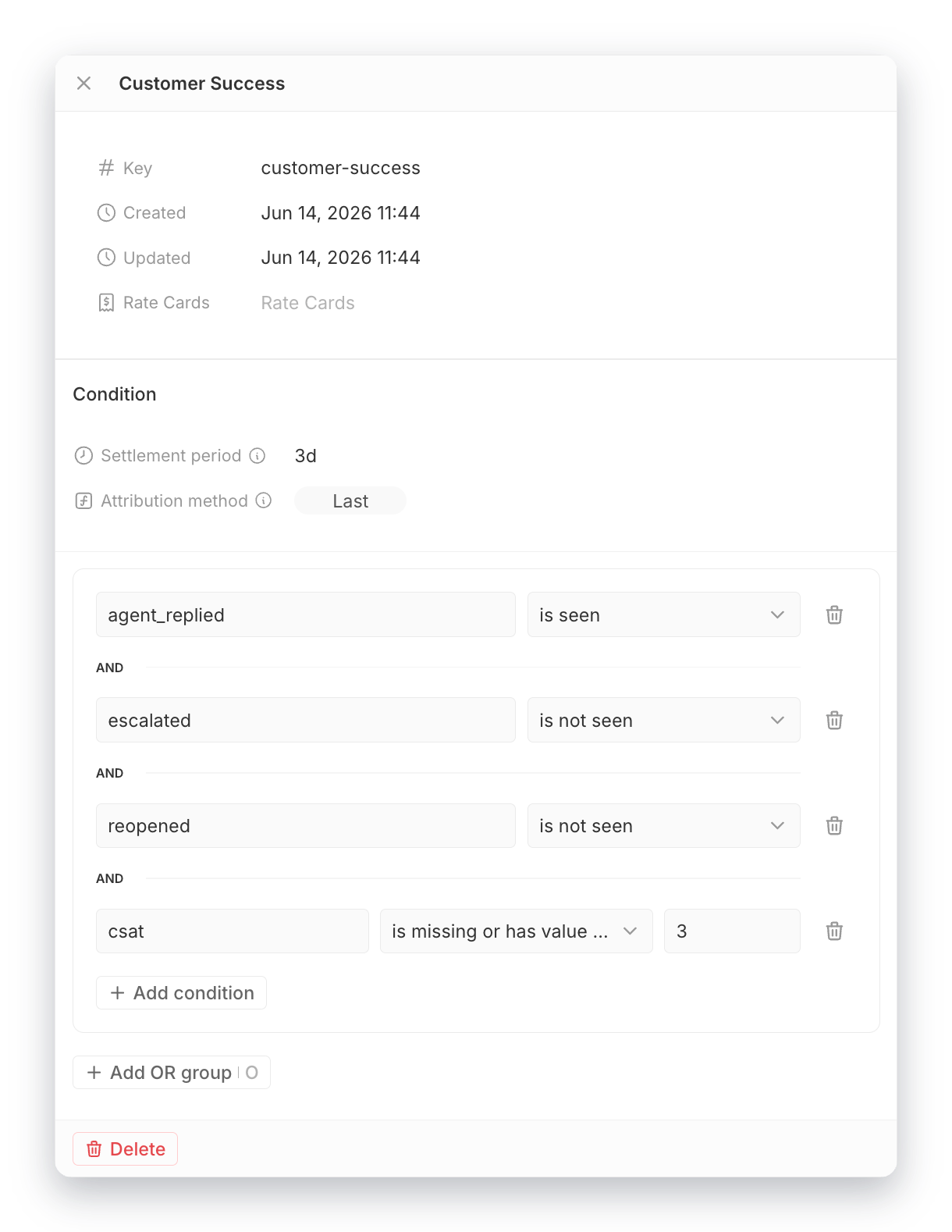
This sentence is not a marketing slogan. It is the requirement for the billing logic that follows. Filling in the blanks forces you to resolve ambiguity upfront. The result translates directly into a billable condition:
Is Your Agent Ready for Outcome Billing?
Outcome billing has one hard prerequisite: your agent must be good at its job. You cannot confidently charge for an outcome the agent delivers inconsistently. Before you can bill for success, you must reliably produce it. Set a minimum performance threshold and hold yourself to it.
As a benchmark, some practitioners suggest the agent should return at least 3x its cost to the customer before the model becomes viable, a threshold discussed in this guide on pricing AI agents. If your agent is not there yet, outcome billing is not off the table forever. Use usage-based pricing as a bridge. Charge for usage first, gather the performance data and build confidence internally and with your customers. Then tie revenue to performance once you can prove the value empirically.
Implementing the Outcome as an Engineering Requirement
A billable outcome is not just a business agreement. It is an engineering requirement and it deserves the same rigor as any other part of your product. Pricing as code. That means explicit success criteria, clear attribution rules and specific exclusions to prevent false positives. Every charge must trace back to a verifiable event logged in your system.
This rigor is what builds long-term trust. It aligns with what Zendesk calls a results-driven framework: the value exchange is explicit and verifiable. When a customer sees exactly what they paid for and why, the invoice stops being a point of contention and becomes a confirmation of value delivered. We covered what that looks like on the invoice itself in How Transparent Invoicing Stops AI Billing Disputes.
witn is built for exactly this. Define the outcome as a condition. Send events as the agent works. The outcome settles into a charge when the condition holds through the settlement window. Read the docs to see how it works.
The complete monetization playbook

How to price, verify and bill the work your AI agent delivers. A practical playbook for founders, product leads and engineers, from choosing a pricing model to operating outcome-based billing in production. 17 pages, free download.
A Buyer's Guide to Outcome-Based AI Pricing
A practical playbook for buying outcome-based AI agents. What to ask vendors, what to demand in the contract and how to compare quotes on equal terms.
Monetizing AI Agents: From Seats to Outcomes
A decision framework for AI agent monetization. Choose between seat, usage, workflow and outcome-based models to align pricing with value.