Moving Existing Customers to Outcome-Based Pricing
How to migrate existing customers to outcome-based pricing. A guide for AI founders on sequencing, comms and avoiding revenue loss.
By George Kats
Most advice on outcome-based pricing assumes you are starting from zero. It imagines a world without existing customers, contracts or revenue streams. This is a fantasy. For any real business, the central challenge is not designing a new model but migrating a paying customer base from an old one.
The work involves careful sequencing, clear communication and robust tooling. It is a process of managing change, not just implementing a new pricing page. This guide provides a practical playbook for the mechanics of this transition, helping you align price with value without breaking the trust you have already built.
The Unspoken Challenge of Outcome Pricing
The real difficulty in an outcome based pricing migration is managing risk. You have existing customers who are accustomed to a certain billing model, whether it is per seat or per API call. Your finance team has revenue forecasts built on that predictable model. A sudden shift introduces uncertainty for everyone. The core task is to de-risk this transition for both your customers and your own business.
This is more than a simple repricing exercise. It is a fundamental saas pricing migration that touches contracts, product and customer success. Get it wrong, and you risk revenue shocks, customer churn or billing disputes. Get it right, and you create a stickier, more defensible partnership where your success is directly tied to the value your customers receive. The rest of this article focuses on the practical steps to achieve this alignment.
Why Greenfield Adoption is a Myth
No successful company starts with a blank slate. If you have product-market fit, you have paying customers. Those customers represent both your success and your legacy constraints. A hard cutover to a new pricing model is rarely feasible because it ignores the relationships and expectations you have already established. The goal is to evolve your pricing to better reflect the value your AI agent delivers, especially as it becomes more efficient.
This is critical because under older models, your own success can work against you. As we have explored before, an AI agent that resolves issues faster or uses fewer actions could perversely shrink your revenue on a usage-based plan. A careful migration is the only way to fix this misalignment without alienating the customers who helped you grow. This methodical approach is a key part of the broader ai agent monetization journey.
Comparing Your Migration Pathways
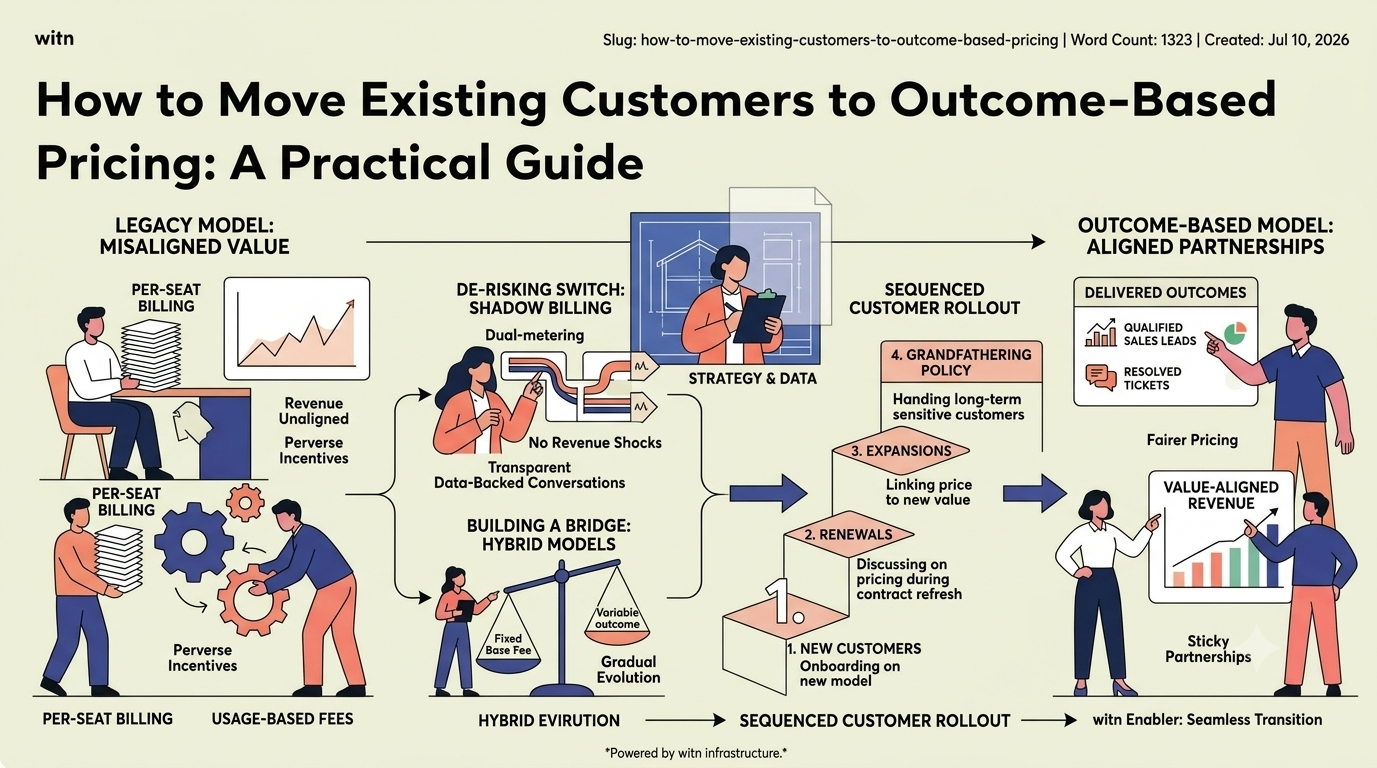
There is no single correct path for a customer pricing model transition. The right strategy depends on your risk tolerance, operational capacity and customer relationships. Most companies will use a combination of approaches for different segments. The four primary pathways are Grandfathering, creating a Hybrid Bridge, running Parallel Shadow-Billing or executing a Hard Cutover. Understanding the trade-offs is the first step in building your migration plan.
| Approach | Revenue Risk | Customer Trust | Operational Effort | Best For |
|---|---|---|---|---|
| Grandfathering | Low (initially) | High | Low | Highly sensitive legacy customers or when the old model is simple to maintain. |
| Hybrid Bridge | Medium | Medium | Medium | Easing customers into variable pricing by combining a fixed fee with a small outcome component. |
| Parallel Shadow-Billing | Low | High | High | De-risking the switch by validating the new model's financial impact before it goes live. |
| Hard Cutover | High | Low | Low | New product lines or when the entire customer base is ready for a fundamental change. |
Building a Bridge with Hybrid Models
A hybrid model is an effective tool for easing the transition. It combines the predictability of a fixed subscription fee with the value alignment of a variable outcome-based component. For example, you might charge a base platform fee that grants access to your AI agent, plus a small metered charge for each qualified sales lead it generates or each support ticket it successfully resolves. This approach acts as a bridge between two different worlds.
The key is to start with a low variable component and ramp it up over time, perhaps at each contract renewal. This strategy makes the change feel like a gradual and logical evolution, not an abrupt shock. It gives customers time to see the fairness of the new model in action while giving your team experience with variable billing. This is a practical step when moving across the different strategies for monetizing AI agents, from seats to outcomes.
De-Risking the Switch with Shadow Billing
The shadow billing strategy, or dual-metering, is the most powerful way to remove uncertainty from a pricing migration. It involves running the new outcome-based model silently in the background while you continue to bill customers on their existing plan. You are essentially generating two invoices for every customer each month: the real one they pay and a "shadow" one they never see. This is not just a back-of-the-napkin calculation. It is a full simulation using live production data.
The primary benefit is concrete data. Before you have a single conversation about repricing, you know exactly how the new model will affect every customer's bill. This data builds internal confidence with your finance and leadership teams. It also transforms the future customer conversation from a negotiation into a data-backed discussion about fairness. This is precisely how you can test your outcome pricing model before launch, but on your live customer base.
Sequencing Your Customer Rollout
A phased rollout is almost always better than a big-bang migration. By sequencing the transition across different customer segments, you minimize risk and create valuable learning loops. This playbook provides a logical order for how to change pricing model cohorts to protect revenue and build momentum.
- Start with all new customers. This is the simplest cohort. They have no legacy expectations and can be onboarded directly onto the new outcome-based model. This builds a future-proof revenue base.
- Target contract renewals next. A renewal is a natural point to discuss pricing. You can frame the new model as a more modern, aligned way to partner for the next term, using performance data from their previous contract to make the case.
- Use expansions as a trigger. When a customer wants to upgrade, add new agent capabilities or expand usage, introduce the new pricing for the incremental value. This links the new model directly to new benefits.
- Decide on a grandfathering policy for the rest. For long-term customers on stable contracts, it may be best to leave them on the legacy plan indefinitely or for a generous period. This protects your most stable relationships from unnecessary disruption.
Framing the Repricing Conversation
Communication is everything. The goal is to frame the pricing change as a positive step toward a better partnership, not a disguised price increase. You must proactively address the primary customer fear: "will my bill go up?". Using the data from your shadow billing period is essential here. You can show customers exactly what their costs would have been on the new model, demonstrating transparency.
For some, the bill may be higher. For others, it may be lower. In all cases, it will be fairer. Anchor the entire conversation on the value they receive by referencing the concrete billable outcomes you have defined. For an SDR agent, this means paying for qualified meetings booked, not for the number of emails sent. This makes the value tangible and the price justifiable.
How witn Enables a Smooth Migration
Managing this transition is complex, but the right infrastructure makes it manageable. witn was built for this exact scenario. Our platform allows you to run an old usage or hybrid model alongside a new outcome-based model for the same customer, using your existing event streams to shadow-compute outcomes without a heavy engineering lift. This provides the data to validate your model, build trust with customers and prepare your finance team. When you and your customer are ready, you can seamlessly transition the contract by adjusting its fixed and variable components. This capability is a core part of the complete guide to AI agent monetization, and you can see how this works in our documentation.
The complete monetization playbook
How to price, verify and bill the work your AI agent delivers. A practical playbook for founders, product leads and engineers, from choosing a pricing model to operating outcome-based billing in production. 17 pages, free download.
Engineering Leader's Guide to Outcome-Based Pricing
A technical guide for engineering leaders on implementing outcome-based pricing for AI agents. Learn the data model, failure modes and rollout strategy.
Deloitte ASC 606 Guidance for Outcome-Based Pricing
A CFO's guide to Deloitte's ASC 606 for AI agents. The five system requirements for auditable outcome-based billing.